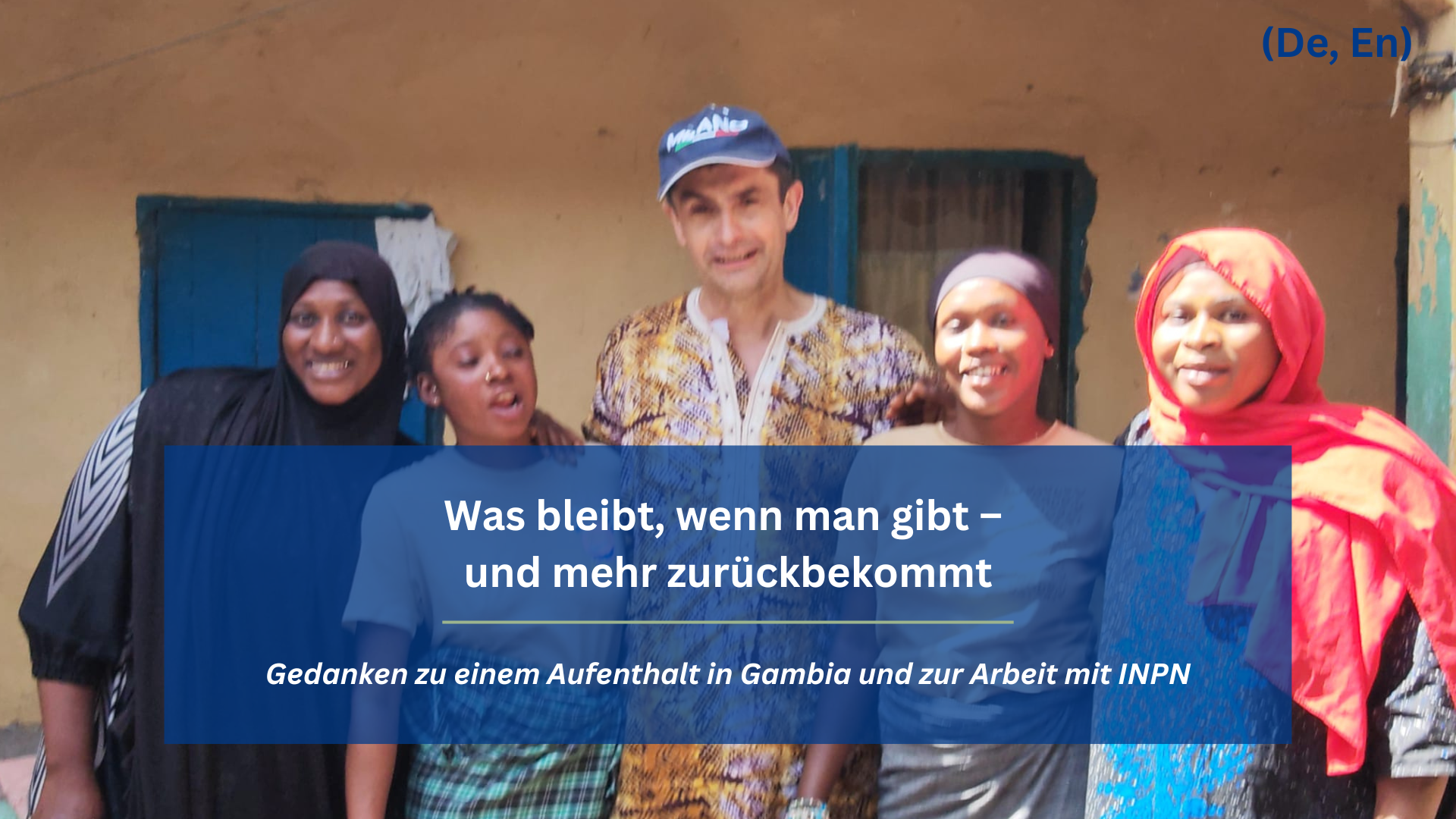
Was bleibt, wenn man gibt – und mehr zurückbekommt?
Gedanken zu einem Aufenthalt in Gambia und zur Arbeit mit INPN
Was bleibt, wenn man gibt – und mehr zurückbekommt
Gedanken zu einem Aufenthalt in Gambia und zur Arbeit mit INPN
Deutsch:
Ich bin nach Gambia gereist, um zu unterstützen. Kleine Projekte, überschaubar, konkret, im Rahmen der NGO INPN, den ich mit anderen Mitstreiter*innen 2008 gründete. Und ich bin zurückgekommen mit einer leisen, aber hartnäckigen Frage:
Ist Entwicklungszusammenarbeit überhaupt der richtige Begriff, wenn man glaubt zu geben – und merkt, dass man selbst der größere Empfänger ist?
Gambia ist kein romantisierter Ort. Aber es ist ein Ort, an dem mir etwas begegnet ist, das in unseren Breiten selten geworden scheint: eine selbstverständliche, alltägliche Freundlichkeit. Menschen gehen herzlich miteinander um. Nicht demonstrativ, nicht aus Höflichkeit – sondern aus Gewohnheit. Der Fremde wird nicht misstrauisch beäugt, sondern wohlwollend wahrgenommen. Manchmal mit Neugier. Oft mit einem Lächeln.
Besonders deutlich wird das im Umgang mit Kindern. Kleinkinder reagieren offen, freundlich, vertrauensvoll. Sie beobachten, kommen näher, lachen. Nicht, weil ständig Erwachsene um sie herumstehen – sondern obwohl sie es nicht tun. Erwachsene sind da, um Grenzen zu wahren, nicht um Kontrolle auszuüben. Als Erwachsener fühlt man sich eingebunden in ein soziales Ganzes. Und als Kind offenbar ebenfalls.
In solchen Momenten fragt man sich unweigerlich, ob Begriffe wie Stress, Burnout, Entspannungskur oder Depression hier nicht tatsächlich Fremdwörter sind – buchstäblich. Nicht weil es keine Probleme gäbe. Sondern weil soziale Nähe, familiäre Einbettung und gegenseitige Verantwortung einen Schutzraum bilden, den wir in unseren hochentwickelten Systemen oft verloren haben, ohne es wirklich zu bemerken.
Und dann steht man da – mit dem Anspruch zu helfen – und spürt:
Vielleicht habe ich mehr von ihnen als sie von mir.
Das macht Entwicklungszusammenarbeit kompliziert. Denn was passiert, wenn Hilfe dazu führt, dass genau dieser soziale und familiäre Schatz in Berührung mit einem System kommt, das zwar effizient ist, aber Menschen krank machen kann? Ein System, das Leistung misst, isoliert, vergleicht – und dabei oft vergisst, was es zu schützen gilt?
Müssten nicht eigentlich sie Entwicklungszusammenarbeit mit uns betreiben?
Und trotzdem: Wegsehen ist keine Lösung. Romantisieren auch nicht.
Gesundheit und Bildung sind reale Hebel. Sie eröffnen Möglichkeiten, ohne soziale Strukturen zwangsläufig zu zerstören. Genau hier setzen die kleinen Projekte von INPN an – bewusst niedrigschwellig, bewusst nah an den Familien.
Diese Reise war auch eine Erkundungstour. Zwei Studentinnen sollten mit eigenen Augen sehen, dass all das keine Übertreibung ist. Dass diese Offenheit, diese soziale Wärme, diese Selbstverständlichkeit real sind. Gleichzeitig ging es ganz konkret darum, Gelder für Patenschaften direkt zu den Eltern zu bringen – damit sie finanziell entlastet werden und ihre Kinder zur Schule schicken können.
Der Betrag ist fast beschämend gering, wenn man ihn aus europäischer Perspektive betrachtet:
30 bis 50 Euro pro Jahr, pro Kind.
Und doch ist die Wirkung enorm. Eltern gewinnen Handlungsspielraum – unabhängig von ihrer sozialen Lage. Schulen können Anträge stellen, etwa für eine Bibliothek. Schul- und Alltagsmaterial kommt direkt bei den Familien an. Kein Umweg, keine abstrakten Programme, kein administrativer Nebel.
Vielleicht ist das die eigentliche Lehre dieser Reise:
Nicht groß helfen. Sondern richtig.
Nicht verändern wollen, was trägt – sondern unterstützen, was stärkt.
Und vor allem: sich dabei selbst infrage stellen. Denn manchmal beginnt Entwicklung nicht dort, wo wir geben – sondern dort, wo wir lernen, genauer hinzusehen.
__________________________________________________________
English:
What Remains When You Give – and Receive More
Reflections on a Stay in The Gambia and Working with INPN
I travelled to The Gambia in order to support. Small projects, modest in scale, concrete in nature, carried out within the framework of the NGO INPN, that I grounded with some fellows in 2008. I returned with a quiet but persistent question:
Is “development cooperation” even the right term when one believes one is giving – and then realizes that one is, in fact, receiving far more?
The Gambia is not a romanticized place. But it is a place where I encountered something that has become rare in many parts of the world: a natural, everyday kindness. People treat one another with warmth – not performatively, not out of politeness, but out of habit. The stranger is not met with suspicion, but with goodwill. Sometimes with curiosity. Often with a smile.
This becomes especially visible in the way children respond. Young children are open, friendly, trusting. They observe, approach, laugh. Not because adults are constantly hovering around them – but despite the fact that they are not. Adults are present to set boundaries, not to control. As an adult, one feels part of a larger whole. And as a child, apparently, one does too.
In moments like these, one inevitably wonders whether words such as stress, burnout, wellness retreat, or depression are not, quite literally, foreign concepts here. Not because life is free of hardship. But because social closeness, family structures, and shared responsibility seem to create a form of protection that we, in our highly developed systems, have largely lost – often without truly noticing.
And then you stand there, with the intention to help, and realize:
Perhaps I have gained more from them than they have from me.
This is where development cooperation becomes complicated. Because what happens when “help” brings this social and familial wealth into contact with a system that may be efficient, but also has the power to make people ill? A system that measures performance, isolates, compares – and often forgets what it should be preserving?
Shouldn’t it really be they who are doing development work with us?
And yet: looking away is not an option. Nor is romanticizing.
Health and education remain real levers. They open opportunities without necessarily destroying social structures. This is precisely where INPN’s small-scale projects are positioned – deliberately low-threshold, deliberately close to families.
This journey was also an exploratory one. Two students were meant to see with their own eyes that none of this is an exaggeration. That this openness, this social warmth, this sense of belonging are real. At the same time, the trip served a very practical purpose: bringing funds for sponsorships directly to parents, easing their financial burden so they can send their children to school.
From a European perspective, the amounts are almost embarrassing in their modesty:
30 to 50 euros per year, per child.
And yet the impact is substantial. Parents gain room to act – regardless of their social circumstances. Schools can submit applications, for example for a library. School supplies and everyday materials reach families directly. No detours. No abstract programs. No administrative fog.
Perhaps this is the central lesson of the journey:
Not to help big – but to help right.
Not to change what sustains people – but to support what strengthens them.
And above all: to question oneself in the process. Because sometimes development does not begin where we give – but where we learn to look more carefully.
Deutsch:
Ich bin nach Gambia gereist, um zu unterstützen. Kleine Projekte, überschaubar, konkret, im Rahmen der NGO INPN, den ich mit anderen Mitstreiter*innen 2008 gründete. Und ich bin zurückgekommen mit einer leisen, aber hartnäckigen Frage:
Ist Entwicklungszusammenarbeit überhaupt der richtige Begriff, wenn man glaubt zu geben – und merkt, dass man selbst der größere Empfänger ist?
Gambia ist kein romantisierter Ort. Aber es ist ein Ort, an dem mir etwas begegnet ist, das in unseren Breiten selten geworden scheint: eine selbstverständliche, alltägliche Freundlichkeit. Menschen gehen herzlich miteinander um. Nicht demonstrativ, nicht aus Höflichkeit – sondern aus Gewohnheit. Der Fremde wird nicht misstrauisch beäugt, sondern wohlwollend wahrgenommen. Manchmal mit Neugier. Oft mit einem Lächeln.
Besonders deutlich wird das im Umgang mit Kindern. Kleinkinder reagieren offen, freundlich, vertrauensvoll. Sie beobachten, kommen näher, lachen. Nicht, weil ständig Erwachsene um sie herumstehen – sondern obwohl sie es nicht tun. Erwachsene sind da, um Grenzen zu wahren, nicht um Kontrolle auszuüben. Als Erwachsener fühlt man sich eingebunden in ein soziales Ganzes. Und als Kind offenbar ebenfalls.
In solchen Momenten fragt man sich unweigerlich, ob Begriffe wie Stress, Burnout, Entspannungskur oder Depression hier nicht tatsächlich Fremdwörter sind – buchstäblich. Nicht weil es keine Probleme gäbe. Sondern weil soziale Nähe, familiäre Einbettung und gegenseitige Verantwortung einen Schutzraum bilden, den wir in unseren hochentwickelten Systemen oft verloren haben, ohne es wirklich zu bemerken.
Und dann steht man da – mit dem Anspruch zu helfen – und spürt:
Vielleicht habe ich mehr von ihnen als sie von mir.
Das macht Entwicklungszusammenarbeit kompliziert. Denn was passiert, wenn Hilfe dazu führt, dass genau dieser soziale und familiäre Schatz in Berührung mit einem System kommt, das zwar effizient ist, aber Menschen krank machen kann? Ein System, das Leistung misst, isoliert, vergleicht – und dabei oft vergisst, was es zu schützen gilt?
Müssten nicht eigentlich sie Entwicklungszusammenarbeit mit uns betreiben?
Und trotzdem: Wegsehen ist keine Lösung. Romantisieren auch nicht.
Gesundheit und Bildung sind reale Hebel. Sie eröffnen Möglichkeiten, ohne soziale Strukturen zwangsläufig zu zerstören. Genau hier setzen die kleinen Projekte von INPN an – bewusst niedrigschwellig, bewusst nah an den Familien.
Diese Reise war auch eine Erkundungstour. Zwei Studentinnen sollten mit eigenen Augen sehen, dass all das keine Übertreibung ist. Dass diese Offenheit, diese soziale Wärme, diese Selbstverständlichkeit real sind. Gleichzeitig ging es ganz konkret darum, Gelder für Patenschaften direkt zu den Eltern zu bringen – damit sie finanziell entlastet werden und ihre Kinder zur Schule schicken können.
Der Betrag ist fast beschämend gering, wenn man ihn aus europäischer Perspektive betrachtet:
30 bis 50 Euro pro Jahr, pro Kind.
Und doch ist die Wirkung enorm. Eltern gewinnen Handlungsspielraum – unabhängig von ihrer sozialen Lage. Schulen können Anträge stellen, etwa für eine Bibliothek. Schul- und Alltagsmaterial kommt direkt bei den Familien an. Kein Umweg, keine abstrakten Programme, kein administrativer Nebel.
Vielleicht ist das die eigentliche Lehre dieser Reise:
Nicht groß helfen. Sondern richtig.
Nicht verändern wollen, was trägt – sondern unterstützen, was stärkt.
Und vor allem: sich dabei selbst infrage stellen. Denn manchmal beginnt Entwicklung nicht dort, wo wir geben – sondern dort, wo wir lernen, genauer hinzusehen.
__________________________________________________________
English:
What Remains When You Give – and Receive More
Reflections on a Stay in The Gambia and Working with INPN
I travelled to The Gambia in order to support. Small projects, modest in scale, concrete in nature, carried out within the framework of the NGO INPN, that I grounded with some fellows in 2008. I returned with a quiet but persistent question:
Is “development cooperation” even the right term when one believes one is giving – and then realizes that one is, in fact, receiving far more?
The Gambia is not a romanticized place. But it is a place where I encountered something that has become rare in many parts of the world: a natural, everyday kindness. People treat one another with warmth – not performatively, not out of politeness, but out of habit. The stranger is not met with suspicion, but with goodwill. Sometimes with curiosity. Often with a smile.
This becomes especially visible in the way children respond. Young children are open, friendly, trusting. They observe, approach, laugh. Not because adults are constantly hovering around them – but despite the fact that they are not. Adults are present to set boundaries, not to control. As an adult, one feels part of a larger whole. And as a child, apparently, one does too.
In moments like these, one inevitably wonders whether words such as stress, burnout, wellness retreat, or depression are not, quite literally, foreign concepts here. Not because life is free of hardship. But because social closeness, family structures, and shared responsibility seem to create a form of protection that we, in our highly developed systems, have largely lost – often without truly noticing.
And then you stand there, with the intention to help, and realize:
Perhaps I have gained more from them than they have from me.
This is where development cooperation becomes complicated. Because what happens when “help” brings this social and familial wealth into contact with a system that may be efficient, but also has the power to make people ill? A system that measures performance, isolates, compares – and often forgets what it should be preserving?
Shouldn’t it really be they who are doing development work with us?
And yet: looking away is not an option. Nor is romanticizing.
Health and education remain real levers. They open opportunities without necessarily destroying social structures. This is precisely where INPN’s small-scale projects are positioned – deliberately low-threshold, deliberately close to families.
This journey was also an exploratory one. Two students were meant to see with their own eyes that none of this is an exaggeration. That this openness, this social warmth, this sense of belonging are real. At the same time, the trip served a very practical purpose: bringing funds for sponsorships directly to parents, easing their financial burden so they can send their children to school.
From a European perspective, the amounts are almost embarrassing in their modesty:
30 to 50 euros per year, per child.
And yet the impact is substantial. Parents gain room to act – regardless of their social circumstances. Schools can submit applications, for example for a library. School supplies and everyday materials reach families directly. No detours. No abstract programs. No administrative fog.
Perhaps this is the central lesson of the journey:
Not to help big – but to help right.
Not to change what sustains people – but to support what strengthens them.
And above all: to question oneself in the process. Because sometimes development does not begin where we give – but where we learn to look more carefully.