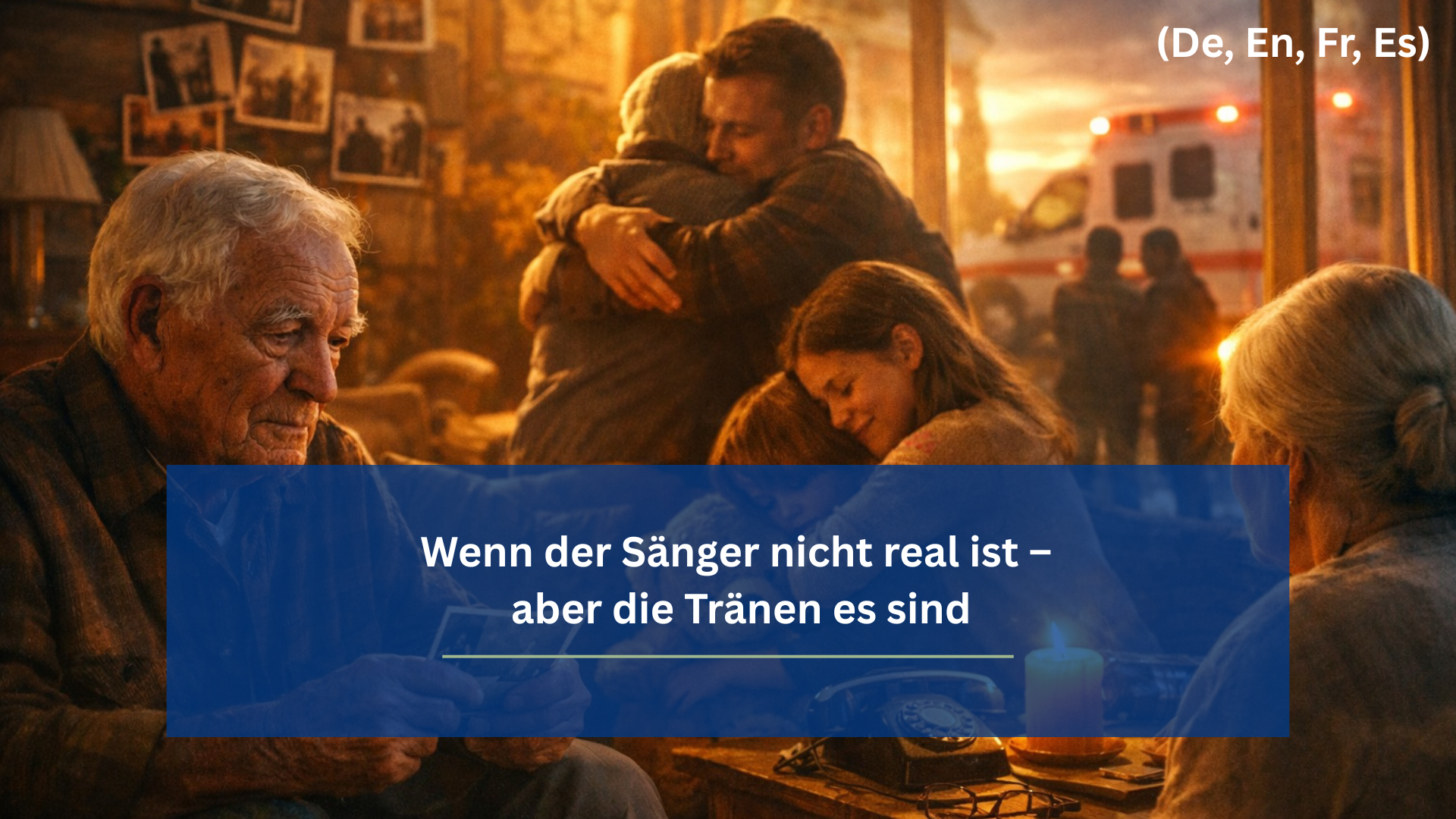
Wenn der Sänger nicht real ist –
aber die Tränen es sind
aber die Tränen es sind
Wenn der Sänger nicht real ist – aber die Tränen es sind
Ende 2025 wurden Millionen von Menschen von einem Country-Gospel-Sänger namens Michael Bennett zu Tränen gerührt. Er stand auf einer Bühne, die aussah wie America’s Got Talent. Er sang von Vätern und Müttern, die auf Kinder warten, die nie anrufen. Von alten Eltern, die allein zurückbleiben. Von Reue. Von Glauben. Von Zeit, die sich nicht zurückdrehen lässt.
Es gab nur ein Problem.
Er existiert nicht.
Seine Stimme ist synthetisch.
Sein Gesicht ist generiert.
Seine Lebensgeschichte ist konstruiert.
Sogar die Jury, die sich Tränen aus den Augen wischt, ist Simulation.
Und doch – die Tränen des Publikums waren real.
Was bedeutet das?
War alles eine Lüge?
Nicht ganz.
Das Authentizitätsparadox
Der Rahmen war künstlich.
Die Performance war künstlich.
Aber die emotionale Reaktion war echt.
Dieses Paradox offenbart etwas Grundsätzliches über unsere Gegenwart: Authentizität bemisst sich heute weniger an der Herkunft einer Stimme als daran, ob sie eine psychologische Wahrheit berührt.
Der KI-Sänger war darauf ausgelegt, bestimmte emotionale Schaltstellen zu aktivieren:
- Der einsame alte Vater – oder die Mutter.
- Das entfremdete Kind.
- Der verpasste Anruf.
- Der leere Stuhl am Küchentisch.
- Der Abschied am Busbahnhof.
- „Ich melde mich bald.“
Das sind keine zufälligen Motive.
Es sind Bindungsverletzungen – kulturell geteilt, leise getragen, selten ausgesprochen.
Die Lieder wurden nicht viral, weil Menschen getäuscht wurden –
sondern weil sie sich selbst darin erkannten.
Vielleicht liegt das eigentliche Unbehagen nicht darin, dass der Sänger künstlich ist –
sondern darin, dass er etwas Reales sichtbar macht, dem wir ausweichen.
Die Rolle des Vaters: Der stille Wartende
In vielen dieser Lieder erscheint der Vater als:
- Wartend.
- Bereuend.
- Allein sitzend.
- Erinnernd.
- Auf Versöhnung hoffend.
Der moderne Vater lebt in einem Spannungsfeld: gesellschaftlich soll er stark und schweigsam sein, emotional verfügbar, ökonomisch leistungsfähig.
Doch wer sieht den alternden Vater, wenn die Kinder gegangen sind?
Wer spricht über väterliche Bindung?
Die klassische Bindungstheorie betonte lange die Mutter-Kind-Beziehung. Doch die Forschung der letzten Jahrzehnte ist eindeutig: Kinder binden sich ebenso tief an ihre Väter. Väter sind keine Nebenfiguren. Sie sind Mitregulatoren emotionaler Sicherheit.
Wenn ein Vater ausgeschlossen wird – durch Konflikt, Trennung, Entfremdung, Distanz, Stolz oder moderne Mobilität –, entsteht ein Bruch im Familiensystem.
Und wenn eine Mutter von ihrem Kind getrennt wird, ist dieser Bruch nicht weniger tief.
Diese Lieder zeigen diesen Bruch.
Darum schmerzen sie.
Die Rolle der Mutter: Emotionaler Anker in einer beschleunigten Welt
Auch wenn sie nicht immer ausdrücklich im Zentrum steht, verkörpert die Mutterfigur häufig:
- Die emotionale Vermittlerin.
- Diejenige, die Beziehungen zusammenhält.
- Die Hüterin der Verbindung.
Doch auch Mütter stehen heute unter immensem Druck: berufliche Anforderungen, Fürsorgearbeit, emotionale Verantwortung, der implizite Imperativ zur Selbstoptimierung.
Die Lieder stellen indirekt Fragen:
Was geschieht, wenn beide Eltern im Leistungsmodus erschöpft sind?
Was geschieht, wenn Bindung hinter Produktivität zurücktritt?
Und wir dürfen nicht vergessen: Auch Mütter werden alt.
Auch Mütter können einsam werden.
Auch Mütter können vergessen werden.
Die Älteren: Die vergessene Generation der Beschleunigung
Die virale Figur ist häufig alt.
Warum?
Weil das Alter offenlegt, was die Jugend noch verdrängen kann.
Im Alter:
- Verblasst Status.
- Verliert Einkommen an Bedeutung.
- Wird Leistung relativ.
- Endet der permanente Wettbewerb.
Was bleibt?
Beziehung.
In realen Krisensituationen – Krankheit, Unfall, plötzlicher Tod, Krieg, Katastrophe – kollabiert die Hierarchie unserer Werte.
Wir rufen nicht unsere beruflichen Kontakte an.
Wir rufen Familie an.
Die Moderne lehrt Autonomie.
Die Krise offenbart Abhängigkeit.
Und Abhängigkeit ist keine Schwäche –
sie ist bindungsbiologische Realität.
Unter Bedrohung sucht das Nervensystem nicht nach Leistung.
Es sucht nach Schutz.
Der Preis der Moderne
Diese Lieder berühren eine kollektive Unruhe:
- Wir sind beschäftigt.
- Wir ziehen um.
- Wir optimieren Zeitpläne.
- Wir verschieben Besuche.
- Wir schreiben Nachrichten statt anzurufen.
- Wir sagen: „Bald.“
Doch Bindung gedeiht nicht durch Effizienz.
Sie gedeiht durch Präsenz.
Die Moderne tauscht Tiefe gegen Geschwindigkeit, Beziehung gegen Bequemlichkeit.
Der Erfolg dieses KI-Sängers legt eine stille Trauer offen: Viele Menschen spüren, dass sie etwas Wesentliches verlieren – und wissen nicht, wie sie es zurückgewinnen können.
Wenn Krisen das Wesentliche freilegen
Bindungssysteme werden unter Bedrohung unmittelbar aktiviert. Die Neurowissenschaft bestätigt: Stress verstärkt das Bedürfnis nach Nähe zu Bindungspersonen.
Das gilt für Kinder.
Das gilt für Erwachsene.
Das gilt für alte Menschen.
Die viralen Lieder inszenieren eine emotionale Krisensituation – ein Elternteil allein, die Zeit knapp, die Möglichkeit eines endgültigen Verlustes.
Und unser Nervensystem reagiert.
Ist es also eine Lüge?
Die Figur ist fiktiv.
Die Bühne ist konstruiert.
Die Dramaturgie ist geplant.
Doch die Bindungsdynamik ist real.
Der KI-Sänger wirkt wie ein kultureller Spiegel – eine synthetische Gestalt, die zutiefst menschliche Ängste reflektiert:
- Die Angst, verlassen zu werden.
- Die Angst, vergessen zu werden.
- Die Angst, unversöhnt zu sterben.
- Die Angst, dass Erfolg Beziehung ersetzt hat.
Vielleicht hat der künstliche Rahmen es ermöglicht, die Abwehr zu senken.
Vielleicht konnte gerade im Gewand der Unterhaltung über Schmerz gesprochen werden.
Familie: Kein Gefühl, sondern ein Regulationssystem
Familie ist nicht nur Nostalgie oder Tradition.
Sie ist ein Regulationssystem.
Kinder benötigen sichere Bindungen zu beiden Elternteilen, um:
- emotionale Stabilität zu entwickeln,
- Stress zu bewältigen,
- eine kohärente Identität auszubilden.
Eltern benötigen Bindung zu ihren Kindern, um:
- Generativität zu erleben,
- Sinn zu erfahren,
- existenzielle Ängste zu regulieren.
Ältere Eltern benötigen Bindung zu erwachsenen Kindern, um:
- Würde zu bewahren,
- Kontinuität zu erleben,
- existenzielle Isolation zu vermeiden.
Wenn diese Bindungen brechen, ist der Verlust nicht nur emotional –
er ist entwicklungspsychologisch relevant.
Warum es viral ging
Weil unter dem künstlichen Bart und dem synthetischen Vibrato etwas ausgesprochen wurde, das viele fühlen, aber selten formulieren:
Wir fürchten, einander zu verlieren, während wir noch leben.
Und vielleicht liegt die tiefere Ironie darin:
In einer Zeit, in der sogar der Sänger künstlich sein kann,
wird die Sehnsucht nach echter Beziehung stärker.
Je virtueller unsere Umwelt wird,
desto existenzieller wird unser Bedürfnis nach Bindung.
Schlussgedanke
Der Rahmen mag künstlich sein.
Aber der Hunger nach Vater.
Nach Mutter.
Nach Versöhnung.
Nach familiärer Präsenz.
Nach sicherer Bindung.
Der ist nicht künstlich.
Vielleicht erzählt der Erfolg dieser KI-Lieder keine Geschichte der Täuschung –
sondern sendet ein Warnsignal aus unserem kollektiven Inneren:
Warte nicht zu lange mit dem Anruf.
Verschiebe Versöhnung nicht.
Verlasse dich nicht darauf, dass noch Zeit bleibt.
Denn in echten Krisen war das Wesentliche immer dasselbe:
Nicht Leistung.
Nicht Reichweite.
Sondern Bindung.
____________________________________
When the Singer Is Not Real — But the Tears Are
In late 2025, millions of people were moved to tears by a country-gospel singer named Michael Bennett. He appeared on a stage that looked like America’s Got Talent. He sang about fathers and mothers waiting for children who never call. About aging parents sitting alone. About regret. About faith. About time that cannot be rewound.
There was only one problem.
He does not exist.
His voice is synthetic.
His face is rendered.
His backstory is engineered.
Even the judges wiping their tears are simulations.
And yet — the tears of the audience were real.
So what does that mean?
Was everything a lie?
Not exactly.
The Authenticity Paradox
The frame was fake.
The performance was artificial.
But the emotional response was genuine.
This paradox reveals something profound about modern life: authenticity today is less about the origin of a voice and more about whether it touches a psychological truth.
The AI singer was designed to press certain emotional buttons:
- The lonely elderly father — or mother.
- The estranged child.
- The missed phone call.
- The empty chair at the kitchen table.
- The bus station goodbye.
- “I’ll call soon.”
These are not random motifs.
They are attachment wounds — culturally shared, quietly carried, rarely spoken.
The songs went viral not because people were fooled — but because people recognized themselves.
Perhaps the deeper discomfort about the AI singer is not that he is fake —
but that he exposes something real we have been avoiding.
The Role of the Father: The Silent Waiter
In many of these songs, the father is portrayed as:
- Waiting.
- Regretting.
- Sitting alone.
- Remembering.
- Hoping for reconciliation.
The modern father carries a paradox: socially expected to be strong and silent, emotionally expected to be available, economically expected to perform.
But who sees the aging father when the children are gone?
Who speaks about paternal attachment?
Attachment theory long emphasized the mother–child bond. Yet contemporary research clearly shows: children attach deeply to fathers as well. Fathers are not secondary figures. They are co-regulators of emotional safety.
When a father is excluded — through conflict, divorce, alienation, distance, pride, or modern mobility — something in the family system fractures.
And when a mother is cut off from her child, the fracture is no less profound.
The AI songs portray that fracture.
That is why they hurt.
The Role of the Mother: Emotional Anchor in a Disrupted World
Even when not explicitly present, the mother figure in these narratives often represents:
- The emotional mediator.
- The one who holds relationships together.
- The keeper of connection.
Yet modern life strains maternal roles as well. Mothers today carry immense pressure: professional expectations, caregiving expectations, emotional labor, and the silent demand for self-optimization.
The songs indirectly ask:
What happens when both parents are exhausted by performance culture?
What happens when attachment becomes secondary to productivity?
And we must not forget: mothers too grow old.
Mothers too can become lonely.
Mothers too can be forgotten.
The Elderly: The Forgotten Generation of Speed
The viral figure is often elderly.
Why?
Because old age exposes what youth can still ignore.
In old age:
- Status fades.
- Income becomes irrelevant.
- Achievement loses its shine.
- Performance stops.
What remains?
Relationship.
In real emergency situations — illness, accident, sudden death, war, disaster — the hierarchy of values collapses instantly.
We do not call our LinkedIn contacts.
We call family.
Modern life teaches autonomy.
Crisis reveals dependency.
And dependency is not weakness — it is attachment reality.
Under threat, the nervous system does not search for performance.
It searches for protection.
The Cost of Modern Life
These songs resonate because they touch a collective anxiety:
- We are busy.
- We relocate.
- We optimize schedules.
- We postpone visits.
- We text instead of call.
- We say “soon.”
But attachment does not thrive on efficiency.
It thrives on presence.
Modern life often trades depth for speed, and connection for convenience.
The success of this AI singer reveals a quiet grief: many people sense they are losing something essential — and they do not know how to retrieve it.
When Emergencies Reveal the Essential
Attachment systems activate immediately under threat. Neuroscience confirms: stress intensifies the need for proximity to attachment figures.
This is true for children.
This is true for adults.
This is true for the elderly.
The viral songs simulate emotional emergency — a parent alone, time running out, the possibility of irreversible loss.
And our nervous systems respond.
Is It a Lie?
The character is fictional.
The stage is fabricated.
The emotional architecture is engineered.
But the attachment dynamics are real.
In a way, the AI singer acts as a cultural mirror — a synthetic figure reflecting very human fears:
- Fear of abandonment.
- Fear of being forgotten.
- Fear of dying unreconciled.
- Fear that success replaced relationship.
Perhaps the artificial frame allowed people to lower their defenses.
Perhaps because it looked like entertainment, it could speak about pain.
The Role of Family: A System, Not a Sentiment
Family is not merely romance, nostalgia, or tradition.
It is a regulatory system.
Children need secure attachment to both parents to develop:
- Emotional stability.
- Stress resilience.
- Identity coherence.
Parents need attachment to their children to:
- Experience generativity.
- Sustain meaning.
- Regulate existential anxiety.
Elderly parents need attachment to adult children to:
- Preserve dignity.
- Experience continuity.
- Avoid existential isolation.
When these bonds fracture, the loss is not merely emotional — it is developmental.
Why It Went Viral
Because beneath the artificial beard and synthetic vibrato, something was articulated that many feel but rarely express:
We are afraid of losing each other while we are still alive.
And perhaps the deeper irony is this:
In an age where even the singer can be artificial,
the longing for real connection grows stronger.
The more virtual our environment becomes,
the more visceral our need for attachment.
Final Thought
The frame may be fake.
But the hunger for father.
For mother.
For reconciliation.
For family presence.
For secure attachment.
That is not fake.
And perhaps the success of these AI songs is not a story about deception —
but a warning signal from our collective psyche:
Do not wait too long to call.
Do not postpone repair.
Do not assume there will be time.
Because in real emergencies, what matters has always been the same.
Not performance.
Not virality.
But attachment.
Now I will provide the German, Spanish and French versions in the next message (to keep clarity and readability).
thank you! now go for it First German
Sehr gern, Jorge.
Hier ist die stilistisch angepasste deutsche Version – nicht wortwörtlich übersetzt, sondern sprachlich und kulturell so gestaltet, dass sie im deutschsprachigen, eher akademisch-professionellen Kontext trägt.
_________________________________
Cuando el cantante no es real — pero las lágrimas sí lo son
A finales de 2025, millones de personas se emocionaron hasta las lágrimas con un cantante de country–góspel llamado Michael Bennett. Aparecía en un escenario que parecía el de America’s Got Talent. Cantaba sobre padres y madres que esperan llamadas que nunca llegan. Sobre padres ancianos sentados en soledad. Sobre el arrepentimiento. Sobre la fe. Sobre el tiempo que no puede retroceder.
Había solo un problema.
No existe.
Su voz es sintética.
Su rostro es generado.
Su biografía es construida.
Incluso los jueces que se secan las lágrimas son simulaciones.
Y, sin embargo, las lágrimas del público eran reales.
¿Qué significa eso?
¿Era todo una mentira?
No exactamente.
La paradoja de la autenticidad
El marco era artificial.
La actuación era artificial.
Pero la respuesta emocional fue auténtica.
Esta paradoja revela algo profundo de nuestra época: hoy la autenticidad no depende tanto del origen de una voz como de su capacidad para tocar una verdad psicológica.
El cantante creado por IA fue diseñado para activar ciertas teclas emocionales:
- El padre anciano — o la madre — en soledad.
- El hijo distanciado.
- La llamada perdida.
- La silla vacía en la mesa de la cocina.
- La despedida en la estación de autobuses.
- “Te llamo pronto.”
No son imágenes casuales.
Son heridas de apego — compartidas culturalmente, llevadas en silencio, rara vez nombradas.
Las canciones se volvieron virales no porque la gente fuera engañada,
sino porque se reconoció en ellas.
Quizá la incomodidad más profunda no radica en que el cantante sea artificial,
sino en que revela algo real que hemos preferido evitar.
El papel del padre: el que espera en silencio
En muchas de estas canciones, el padre aparece como:
- El que espera.
- El que lamenta.
- El que se queda solo.
- El que recuerda.
- El que todavía espera reconciliación.
El padre contemporáneo vive una paradoja: socialmente se le exige fortaleza y silencio; emocionalmente, disponibilidad; económicamente, rendimiento constante.
Pero ¿quién ve al padre que envejece cuando los hijos se han ido?
¿Quién habla del apego paterno?
Durante mucho tiempo, la teoría del apego puso el foco en la relación madre–hijo. Sin embargo, la investigación actual es clara: los niños se vinculan profundamente también con sus padres. El padre no es una figura secundaria. Es co-regulador de la seguridad emocional.
Cuando un padre es excluido — por conflicto, separación, alienación, distancia, orgullo o movilidad moderna — algo se fractura en el sistema familiar.
Y cuando una madre es separada de su hijo, la fractura no es menos profunda.
Estas canciones retratan esa fractura.
Por eso duelen.
El papel de la madre: ancla emocional en un mundo acelerado
Aunque no siempre esté en el centro explícito del relato, la figura materna suele representar:
- La mediadora emocional.
- La que sostiene los vínculos.
- La guardiana de la conexión.
Pero la vida moderna también tensiona profundamente el rol materno: exigencias profesionales, cuidados constantes, trabajo emocional invisible, presión por la autoexigencia permanente.
Las canciones plantean preguntas implícitas:
¿Qué ocurre cuando ambos padres están agotados por la cultura del rendimiento?
¿Qué ocurre cuando el apego queda subordinado a la productividad?
Y no debemos olvidar:
Las madres también envejecen.
Las madres también pueden quedarse solas.
Las madres también pueden ser olvidadas.
Los mayores: la generación olvidada de la velocidad
La figura viral suele ser anciana.
¿Por qué?
Porque la vejez revela lo que la juventud todavía puede ignorar.
En la vejez:
- El estatus pierde peso.
- El dinero deja de ser central.
- El logro pierde brillo.
- El rendimiento deja de ser el criterio dominante.
¿Qué queda?
La relación, el vínculo
En situaciones reales de emergencia — enfermedad, accidente, muerte repentina, guerra, desastre — la jerarquía de valores se derrumba.
No llamamos a nuestros contactos profesionales.
Llamamos a la familia.
La modernidad nos enseña autonomía.
La crisis revela dependencia.
Y la dependencia no es debilidad — es realidad del apego.
Bajo amenaza, el sistema nervioso no busca rendimiento.
Busca protección.
El costo de la vida moderna
Estas canciones conectan con una ansiedad colectiva:
- Estamos ocupados.
- Cambiamos de ciudad.
- Optimizamos agendas.
- Postergamos visitas.
- Enviamos mensajes en lugar de llamar.
- Decimos “pronto”.
Pero el apego no prospera con eficiencia.
Prospera con presencia.
La vida moderna intercambia profundidad por velocidad, vínculo por conveniencia.
El éxito de este cantante virtual revela un duelo silencioso: muchas personas intuyen que están perdiendo algo esencial — y no saben cómo recuperarlo.
Cuando la emergencia revela lo esencial
Los sistemas de apego, de vínculo, de relación emocional se activan inmediatamente ante la amenaza. La neurociencia confirma que el estrés intensifica la necesidad de proximidad con las figuras de apego.
Esto es cierto para los niños.
Para los adultos.
Para los ancianos.
Las canciones virales simulan una emergencia emocional: un padre o una madre en soledad, el tiempo que se agota, la posibilidad de una pérdida irreversible.
Y nuestro sistema nervioso responde.
¿Es entonces una mentira?
El personaje es ficticio.
El escenario es fabricado.
La arquitectura emocional está diseñada.
Pero la dinámica del apego es real.
El cantante artificial funciona como un espejo cultural: una figura sintética que refleja miedos profundamente humanos:
- El miedo al abandono.
- El miedo al olvido.
- El miedo a morir sin reconciliación.
- El miedo a que el éxito haya sustituido a la relación.
Tal vez el marco artificial permitió bajar las defensas.
Tal vez, bajo la forma de entretenimiento, fue posible hablar del dolor.
La familia: no solo sentimiento, sino sistema regulador
La familia no es solo tradición o nostalgia.
Es un sistema regulador.
Los niños necesitan apego seguro con ambos padres para desarrollar:
- Estabilidad emocional.
- Resiliencia ante el estrés.
- Identidad coherente.
Los padres necesitan el vínculo con sus hijos para:
- Experimentar generatividad.
- Mantener sentido vital.
- Regular la ansiedad existencial.
Los padres mayores necesitan el vínculo con sus hijos adultos para:
- Conservar dignidad.
- Sentir continuidad.
- Evitar el aislamiento existencial.
Cuando estos vínculos se fracturan, la pérdida no es solo emocional — es evolutiva.
¿Por qué se hizo viral?
Porque detrás de la barba artificial y del vibrato sintético se expresó algo que muchos sienten pero pocos formulan:
Tenemos miedo de perdernos unos a otros mientras aún estamos vivos.
Y quizá la ironía más profunda sea esta:
En una época en la que incluso el cantante puede ser artificial,
el anhelo de conexión real se vuelve más intenso.
Cuanto más virtual es nuestro entorno,
más visceral se vuelve nuestra necesidad de apego.
Reflexión final
El marco puede ser artificial.
Pero el hambre de padre.
De madre.
De reconciliación.
De presencia familiar.
De apego seguro.
Eso no es artificial.
Quizá el éxito de estas canciones creadas por IA no sea una historia sobre engaño,
sino una señal de alarma de nuestra psique colectiva:
No esperes demasiado para llamar.
No postergues la reparación.
No des por hecho que habrá tiempo.
Porque en las verdaderas emergencias, lo esencial siempre ha sido lo mismo:
No el rendimiento.
No la visibilidad.
Sino nuestros vínculos emocionales.
___________________________________
Quand le chanteur n’est pas réel — mais que les larmes le sont
Fin 2025, des millions de personnes ont été émues aux larmes par un chanteur de country-gospel nommé Michael Bennett. Il apparaissait sur une scène ressemblant à celle de America’s Got Talent. Il chantait des pères et des mères qui attendent des enfants qui n’appellent jamais. Des parents âgés assis dans la solitude. Le regret. La foi. Le temps qui ne revient pas.
Il n’y avait qu’un problème.
Il n’existe pas.
Sa voix est synthétique.
Son visage est généré.
Son histoire est construite.
Même les juges essuyant leurs larmes sont des simulations.
Et pourtant — les larmes du public étaient réelles.
Que signifie alors cette émotion ?
Tout était-il mensonge ?
Pas exactement.
Le paradoxe de l’authenticité
Le cadre était artificiel.
La performance était artificielle.
Mais la réaction émotionnelle était authentique.
Ce paradoxe dit quelque chose d’essentiel sur notre modernité : aujourd’hui, l’authenticité ne dépend plus tant de l’origine d’une voix que de sa capacité à toucher une vérité psychique.
Le chanteur créé par intelligence artificielle a été conçu pour activer certaines résonances émotionnelles :
- Le père âgé — ou la mère — laissé dans la solitude.
- L’enfant devenu distant.
- L’appel manqué.
- La chaise vide à la table de la cuisine.
- L’adieu à la gare routière.
- « Je t’appelle bientôt. »
Ces images ne sont pas anodines.
Elles renvoient à des blessures d’attachement — partagées culturellement, portées en silence, rarement formulées.
Les chansons sont devenues virales non parce que le public aurait été dupe,
mais parce qu’il s’y est reconnu.
Peut-être que le véritable malaise ne réside pas dans le caractère artificiel du chanteur,
mais dans le fait qu’il révèle une réalité que nous évitons de regarder.
Le rôle du père : celui qui attend en silence
Dans ces récits musicaux, le père apparaît souvent comme :
- Celui qui attend.
- Celui qui regrette.
- Celui qui reste seul.
- Celui qui se souvient.
- Celui qui espère encore une réconciliation.
Le père contemporain est pris dans une tension : on attend de lui qu’il soit fort et discret, affectivement disponible, économiquement performant.
Mais qui voit le père vieillissant lorsque les enfants sont partis ?
Qui parle de l’attachement paternel ?
La théorie classique de l’attachement a longtemps mis l’accent sur la relation mère–enfant. Or les recherches contemporaines sont claires : l’enfant développe des liens d’attachement profonds également avec son père. Le père n’est pas une figure secondaire. Il participe activement à la régulation de la sécurité émotionnelle.
Lorsque le père est exclu — par conflit, séparation, éloignement, aliénation, orgueil ou mobilité moderne — une fracture se produit dans le système familial.
Et lorsqu’une mère est séparée de son enfant, la fracture n’est en rien moins profonde.
Ces chansons mettent en scène cette fracture.
C’est pourquoi elles touchent si intensément.
Le rôle de la mère : ancrage émotionnel dans un monde accéléré
Même lorsqu’elle n’est pas explicitement au centre du récit, la figure maternelle incarne souvent :
- La médiatrice émotionnelle.
- Celle qui maintient les liens.
- La gardienne de la continuité relationnelle.
Mais la modernité exerce également une pression considérable sur les mères : exigences professionnelles, charge de soins, travail émotionnel invisible, impératif de performance et d’auto-optimisation.
Ces chansons posent implicitement des questions :
Que devient la relation lorsque les deux parents sont épuisés par la culture de la performance ?
Que se passe-t-il lorsque l’attachement est relégué derrière la productivité ?
Et il ne faut pas l’oublier :
Les mères vieillissent elles aussi.
Les mères peuvent elles aussi connaître la solitude.
Les mères peuvent elles aussi être oubliées.
Les personnes âgées : la génération oubliée de l’accélération
La figure centrale est souvent âgée.
Pourquoi ?
Parce que la vieillesse met à nu ce que la jeunesse peut encore ignorer.
Avec l’âge :
- Le statut perd de son importance.
- Le revenu cesse d’être déterminant.
- La réussite perd son éclat.
- La performance n’est plus le critère dominant.
Que reste-t-il ?
La relation.
Dans les situations d’urgence — maladie grave, accident, décès soudain, guerre, catastrophe — la hiérarchie des priorités s’effondre.
Nous n’appelons pas nos contacts professionnels.
Nous appelons notre famille.
La modernité valorise l’autonomie.
La crise révèle la dépendance.
Or la dépendance n’est pas une faiblesse —
elle est une réalité fondamentale de l’attachement.
Face à la menace, le système nerveux ne cherche pas la performance.
Il cherche la protection.
Le coût de la modernité
Ces chansons rencontrent un écho parce qu’elles touchent une inquiétude collective :
- Nous sommes occupés.
- Nous changeons de ville.
- Nous optimisons nos agendas.
- Nous remettons les visites à plus tard.
- Nous envoyons des messages au lieu d’appeler.
- Nous disons : « bientôt ».
Mais l’attachement ne se nourrit pas d’efficacité.
Il se nourrit de présence.
La modernité échange souvent la profondeur contre la vitesse,
le lien contre la commodité.
Le succès de ce chanteur virtuel révèle un deuil discret : beaucoup pressentent qu’ils perdent quelque chose d’essentiel — sans savoir comment le retrouver.
Quand l’urgence révèle l’essentiel
Les systèmes d’attachement s’activent immédiatement en situation de menace. Les données neuroscientifiques confirment que le stress intensifie le besoin de proximité avec les figures d’attachement.
Cela vaut pour les enfants.
Pour les adultes.
Pour les personnes âgées.
Ces chansons simulent une urgence émotionnelle : un parent seul, le temps qui s’épuise, la possibilité d’une perte irréversible.
Et notre système nerveux répond.
Est-ce alors un mensonge ?
Le personnage est fictif.
La scène est construite.
La dramaturgie est calculée.
Mais les dynamiques d’attachement sont bien réelles.
Le chanteur artificiel fonctionne comme un miroir culturel : une figure synthétique qui reflète des peurs profondément humaines :
- La peur de l’abandon.
- La peur d’être oublié.
- La peur de mourir sans réconciliation.
- La peur que la réussite ait remplacé la relation.
Peut-être que le cadre artificiel a permis d’abaisser les défenses.
Peut-être que, sous couvert de divertissement, la douleur a pu être dite.La famille : non pas un sentiment, mais un système de régulation
La famille n’est pas seulement une tradition ou une nostalgie.
Elle est un système de régulation.
Les enfants ont besoin d’attachements sécurisants avec leurs deux parents pour développer :
- Une stabilité émotionnelle.
- Une résilience face au stress.
- Une identité cohérente.
Les parents ont besoin du lien avec leurs enfants pour :
- Faire l’expérience de la générativité.
- Maintenir un sens à leur existence.
- Réguler l’angoisse existentielle.
Les parents âgés ont besoin du lien avec leurs enfants adultes pour :
- Préserver leur dignité.
- Sentir une continuité.
- Éviter l’isolement existentiel.
Lorsque ces liens se rompent, la perte n’est pas seulement affective —
elle est développementale.
Pourquoi cela est devenu viral
Parce que derrière la barbe artificielle et le vibrato synthétique s’est exprimée une vérité que beaucoup ressentent sans la formuler :
Nous avons peur de nous perdre les uns les autres alors que nous sommes encore en vie.
Et peut-être l’ironie la plus profonde est-elle celle-ci :
À une époque où même le chanteur peut être artificiel,
le désir de relation réelle s’intensifie.
Plus notre environnement devient virtuel,
plus notre besoin d’attachement devient viscéral.
Réflexion finale
Le cadre peut être artificiel.
Mais le besoin de père.
De mère.
De réconciliation.
De présence familiale.
D’attachement sécurisant.
Cela n’a rien d’artificiel.
Peut-être que le succès de ces chansons issues de l’intelligence artificielle ne raconte pas une histoire de tromperie,
mais constitue un signal d’alarme de notre psyché collective :
N’attendez pas trop longtemps pour appeler.
Ne remettez pas la réparation à plus tard.
Ne supposez pas qu’il restera du temps.
Car dans les véritables urgences, l’essentiel a toujours été le même :
Non pas la performance.
Non pas la visibilité.
Mais l’attachement.
MAKING OF
When the Singer Is Not Real — But the Tears Are
In late 2025, millions of people were moved to tears by a country-gospel singer named Michael Bennett. He appeared on a stage that looked like America’s Got Talent. He sang about fathers or mothers waiting for their children who never call. About old parents sitting alone. About regret. About faith. About time that cannot be rewound.
There was only one problem:
He does not exist.
His voice is synthetic.
His face is rendered.
His backstory is engineered.
Even the judges wiping their tears are simulations.
And yet — the tears of the audience were real.
So what does that mean?
Was everything a lie?
Not exactly.
The Authenticity Paradox
The frame was fake.
The performance was artificial.
But the emotional response was genuine.
This paradox reveals something profound about modern life: authenticity today is less about the origin of a voice and more about whether it touches a psychological truth.
The AI singer was designed to press certain emotional buttons:
- The lonely elderly father (it could be a mother as well).
- The estranged child.
- The missed phone call.
- The empty chair at the kitchen table.
- The bus station goodbye.
- “I’ll call soon.”
These are not random motifs. They are attachment wounds.
The songs went viral not because people were fooled — but because people recognized themselves.
The Role of the Father: The Silent Waiter
In many of these songs, the father is portrayed as:
- Waiting.
- Regretting.
- Sitting alone.
- Remembering.
- Hoping for reconciliation.
The modern father often carries a paradox: socially expected to be strong and silent, emotionally expected to be available, economically expected to perform.
But who sees the aging father when the children are gone?
Who speaks about paternal attachment?
Attachment theory has long emphasized the mother-child bond, but contemporary research clearly shows: children attach deeply to fathers as well. Fathers are not secondary. They are co-regulators of emotional safety.
When a father is excluded — through conflict, divorce, alienation, distance, pride, or modern mobility — something in the family system fractures.
The AI songs portray that fracture.
That is why they hurt.
The Role of the Mother: Emotional Anchor in a Disrupted World
Even when not explicitly present, the mother figure in these narratives often represents:
- The emotional mediator.
- The one who holds relationships together.
- The keeper of connection.
But modern life strains maternal roles as well. Mothers today carry immense pressure: professional expectations, caregiving expectations, emotional labor, self-optimization culture.
The songs indirectly ask:
What happens when both parents are exhausted by modern performance demands?
What happens when attachment becomes secondary to productivity?
And not to forget. Mothers are also to be found old, lonely, forgotten. Just as well as fathers.
The Elderly: The Forgotten Generation of Speed
The viral character is often elderly.
Why?
Because old age exposes what youth can ignore.
In old age:
- Status fades.
- Income becomes irrelevant.
- Achievement means little.
- Performance stops.
What remains?
Relationship.
In emergency situations — illness, accident, death, war, disaster — we do not call our LinkedIn contacts.
We call family.
Modern life teaches autonomy.
Crisis reveals dependency.
And dependency is not weakness — it is attachment reality.
The Cost of Modern Life
The songs resonate because they touch a collective anxiety:
- We are busy.
- We move cities.
- We optimize schedules.
- We postpone visits.
- We text instead of call.
- We say “soon.”
But attachment does not thrive on efficiency.
It thrives on presence.
Modern life often trades depth for speed, and connection for convenience.
The AI singer’s success reveals a quiet grief: many people suspect they are losing something essential — and they do not know how to retrieve it.
When Emergencies Reveal the Essential
In real emergency situations — medical crises, sudden death, natural disasters — the hierarchy of values collapses instantly.
No one asks:
- How many followers did you have?
- How optimized was your productivity?
- How viral were your achievements?
We ask:
- Are you safe?
- Are you here?
- Can I hold you?
- Can I forgive you?
- Can we reconcile?
Attachment systems activate immediately under threat. Neuroscience confirms: stress intensifies the need for proximity to attachment figures.
This is true for children.
This is true for adults.
This is true for the elderly.
The viral songs simulate emotional emergency — a father alone, time running out, the possibility of irreversible loss.
And our nervous systems respond.
Is It a Lie?
The character is fictional.
The stage is fabricated.
The emotional architecture is engineered.
But the attachment dynamics are real.
In a way, the AI singer acts like a cultural mirror. He is a synthetic figure reflecting very human fears:
- Fear of abandonment.
- Fear of being forgotten.
- Fear of dying unreconciled.
- Fear that success replaced relationship.
Perhaps the “fake” frame allowed people to lower their defenses.
Perhaps because it looked like entertainment, it could speak about pain.
The Role of Family: A System, Not a Sentiment
Family is not just romance, nostalgia, or tradition.
It is a regulatory system.
Children need secure attachment to both parents to develop:
- Emotional stability.
- Stress resilience.
- Identity coherence.
Parents need attachment to children to:
- Experience generativity.
- Sustain meaning.
- Regulate aging fears.
Elderly parents need attachment to adult children to:
- Preserve dignity.
- Feel continuity.
- Avoid existential isolation.
When these bonds fracture, the loss is not merely emotional — it is developmental.
Why the AI Singer Went Viral
Because beneath the artificial beard and synthetic vibrato, he articulated something many feel but rarely express:
We are afraid of losing each other while we are still alive.
And perhaps the deeper irony is this:
In an age where even the singer can be artificial,
the longing for real connection becomes stronger.
The more virtual our environment becomes,
the more visceral our need for attachment.
Final Thought
The frame may be fake.
But the hunger for father.
For mother.
For reconciliation.
For family presence.
For secure attachment.
That is not fake.
And maybe the success of these AI songs is less a story about deception —
and more a warning signal from our collective psyche:
Do not wait too long to call.
Do not postpone repair.
Do not assume there will be time.
Because in real emergencies, what matters has always been the same.
Not performance.
Not virality.
But attachment.
Ende 2025 wurden Millionen von Menschen von einem Country-Gospel-Sänger namens Michael Bennett zu Tränen gerührt. Er stand auf einer Bühne, die aussah wie America’s Got Talent. Er sang von Vätern und Müttern, die auf Kinder warten, die nie anrufen. Von alten Eltern, die allein zurückbleiben. Von Reue. Von Glauben. Von Zeit, die sich nicht zurückdrehen lässt.
Es gab nur ein Problem.
Er existiert nicht.
Seine Stimme ist synthetisch.
Sein Gesicht ist generiert.
Seine Lebensgeschichte ist konstruiert.
Sogar die Jury, die sich Tränen aus den Augen wischt, ist Simulation.
Und doch – die Tränen des Publikums waren real.
Was bedeutet das?
War alles eine Lüge?
Nicht ganz.
Das Authentizitätsparadox
Der Rahmen war künstlich.
Die Performance war künstlich.
Aber die emotionale Reaktion war echt.
Dieses Paradox offenbart etwas Grundsätzliches über unsere Gegenwart: Authentizität bemisst sich heute weniger an der Herkunft einer Stimme als daran, ob sie eine psychologische Wahrheit berührt.
Der KI-Sänger war darauf ausgelegt, bestimmte emotionale Schaltstellen zu aktivieren:
- Der einsame alte Vater – oder die Mutter.
- Das entfremdete Kind.
- Der verpasste Anruf.
- Der leere Stuhl am Küchentisch.
- Der Abschied am Busbahnhof.
- „Ich melde mich bald.“
Das sind keine zufälligen Motive.
Es sind Bindungsverletzungen – kulturell geteilt, leise getragen, selten ausgesprochen.
Die Lieder wurden nicht viral, weil Menschen getäuscht wurden –
sondern weil sie sich selbst darin erkannten.
Vielleicht liegt das eigentliche Unbehagen nicht darin, dass der Sänger künstlich ist –
sondern darin, dass er etwas Reales sichtbar macht, dem wir ausweichen.
Die Rolle des Vaters: Der stille Wartende
In vielen dieser Lieder erscheint der Vater als:
- Wartend.
- Bereuend.
- Allein sitzend.
- Erinnernd.
- Auf Versöhnung hoffend.
Der moderne Vater lebt in einem Spannungsfeld: gesellschaftlich soll er stark und schweigsam sein, emotional verfügbar, ökonomisch leistungsfähig.
Doch wer sieht den alternden Vater, wenn die Kinder gegangen sind?
Wer spricht über väterliche Bindung?
Die klassische Bindungstheorie betonte lange die Mutter-Kind-Beziehung. Doch die Forschung der letzten Jahrzehnte ist eindeutig: Kinder binden sich ebenso tief an ihre Väter. Väter sind keine Nebenfiguren. Sie sind Mitregulatoren emotionaler Sicherheit.
Wenn ein Vater ausgeschlossen wird – durch Konflikt, Trennung, Entfremdung, Distanz, Stolz oder moderne Mobilität –, entsteht ein Bruch im Familiensystem.
Und wenn eine Mutter von ihrem Kind getrennt wird, ist dieser Bruch nicht weniger tief.
Diese Lieder zeigen diesen Bruch.
Darum schmerzen sie.
Die Rolle der Mutter: Emotionaler Anker in einer beschleunigten Welt
Auch wenn sie nicht immer ausdrücklich im Zentrum steht, verkörpert die Mutterfigur häufig:
- Die emotionale Vermittlerin.
- Diejenige, die Beziehungen zusammenhält.
- Die Hüterin der Verbindung.
Doch auch Mütter stehen heute unter immensem Druck: berufliche Anforderungen, Fürsorgearbeit, emotionale Verantwortung, der implizite Imperativ zur Selbstoptimierung.
Die Lieder stellen indirekt Fragen:
Was geschieht, wenn beide Eltern im Leistungsmodus erschöpft sind?
Was geschieht, wenn Bindung hinter Produktivität zurücktritt?
Und wir dürfen nicht vergessen: Auch Mütter werden alt.
Auch Mütter können einsam werden.
Auch Mütter können vergessen werden.
Die Älteren: Die vergessene Generation der Beschleunigung
Die virale Figur ist häufig alt.
Warum?
Weil das Alter offenlegt, was die Jugend noch verdrängen kann.
Im Alter:
- Verblasst Status.
- Verliert Einkommen an Bedeutung.
- Wird Leistung relativ.
- Endet der permanente Wettbewerb.
Was bleibt?
Beziehung.
In realen Krisensituationen – Krankheit, Unfall, plötzlicher Tod, Krieg, Katastrophe – kollabiert die Hierarchie unserer Werte.
Wir rufen nicht unsere beruflichen Kontakte an.
Wir rufen Familie an.
Die Moderne lehrt Autonomie.
Die Krise offenbart Abhängigkeit.
Und Abhängigkeit ist keine Schwäche –
sie ist bindungsbiologische Realität.
Unter Bedrohung sucht das Nervensystem nicht nach Leistung.
Es sucht nach Schutz.
Der Preis der Moderne
Diese Lieder berühren eine kollektive Unruhe:
- Wir sind beschäftigt.
- Wir ziehen um.
- Wir optimieren Zeitpläne.
- Wir verschieben Besuche.
- Wir schreiben Nachrichten statt anzurufen.
- Wir sagen: „Bald.“
Doch Bindung gedeiht nicht durch Effizienz.
Sie gedeiht durch Präsenz.
Die Moderne tauscht Tiefe gegen Geschwindigkeit, Beziehung gegen Bequemlichkeit.
Der Erfolg dieses KI-Sängers legt eine stille Trauer offen: Viele Menschen spüren, dass sie etwas Wesentliches verlieren – und wissen nicht, wie sie es zurückgewinnen können.
Wenn Krisen das Wesentliche freilegen
Bindungssysteme werden unter Bedrohung unmittelbar aktiviert. Die Neurowissenschaft bestätigt: Stress verstärkt das Bedürfnis nach Nähe zu Bindungspersonen.
Das gilt für Kinder.
Das gilt für Erwachsene.
Das gilt für alte Menschen.
Die viralen Lieder inszenieren eine emotionale Krisensituation – ein Elternteil allein, die Zeit knapp, die Möglichkeit eines endgültigen Verlustes.
Und unser Nervensystem reagiert.
Ist es also eine Lüge?
Die Figur ist fiktiv.
Die Bühne ist konstruiert.
Die Dramaturgie ist geplant.
Doch die Bindungsdynamik ist real.
Der KI-Sänger wirkt wie ein kultureller Spiegel – eine synthetische Gestalt, die zutiefst menschliche Ängste reflektiert:
- Die Angst, verlassen zu werden.
- Die Angst, vergessen zu werden.
- Die Angst, unversöhnt zu sterben.
- Die Angst, dass Erfolg Beziehung ersetzt hat.
Vielleicht hat der künstliche Rahmen es ermöglicht, die Abwehr zu senken.
Vielleicht konnte gerade im Gewand der Unterhaltung über Schmerz gesprochen werden.
Familie: Kein Gefühl, sondern ein Regulationssystem
Familie ist nicht nur Nostalgie oder Tradition.
Sie ist ein Regulationssystem.
Kinder benötigen sichere Bindungen zu beiden Elternteilen, um:
- emotionale Stabilität zu entwickeln,
- Stress zu bewältigen,
- eine kohärente Identität auszubilden.
Eltern benötigen Bindung zu ihren Kindern, um:
- Generativität zu erleben,
- Sinn zu erfahren,
- existenzielle Ängste zu regulieren.
Ältere Eltern benötigen Bindung zu erwachsenen Kindern, um:
- Würde zu bewahren,
- Kontinuität zu erleben,
- existenzielle Isolation zu vermeiden.
Wenn diese Bindungen brechen, ist der Verlust nicht nur emotional –
er ist entwicklungspsychologisch relevant.
Warum es viral ging
Weil unter dem künstlichen Bart und dem synthetischen Vibrato etwas ausgesprochen wurde, das viele fühlen, aber selten formulieren:
Wir fürchten, einander zu verlieren, während wir noch leben.
Und vielleicht liegt die tiefere Ironie darin:
In einer Zeit, in der sogar der Sänger künstlich sein kann,
wird die Sehnsucht nach echter Beziehung stärker.
Je virtueller unsere Umwelt wird,
desto existenzieller wird unser Bedürfnis nach Bindung.
Schlussgedanke
Der Rahmen mag künstlich sein.
Aber der Hunger nach Vater.
Nach Mutter.
Nach Versöhnung.
Nach familiärer Präsenz.
Nach sicherer Bindung.
Der ist nicht künstlich.
Vielleicht erzählt der Erfolg dieser KI-Lieder keine Geschichte der Täuschung –
sondern sendet ein Warnsignal aus unserem kollektiven Inneren:
Warte nicht zu lange mit dem Anruf.
Verschiebe Versöhnung nicht.
Verlasse dich nicht darauf, dass noch Zeit bleibt.
Denn in echten Krisen war das Wesentliche immer dasselbe:
Nicht Leistung.
Nicht Reichweite.
Sondern Bindung.
____________________________________
When the Singer Is Not Real — But the Tears Are
In late 2025, millions of people were moved to tears by a country-gospel singer named Michael Bennett. He appeared on a stage that looked like America’s Got Talent. He sang about fathers and mothers waiting for children who never call. About aging parents sitting alone. About regret. About faith. About time that cannot be rewound.
There was only one problem.
He does not exist.
His voice is synthetic.
His face is rendered.
His backstory is engineered.
Even the judges wiping their tears are simulations.
And yet — the tears of the audience were real.
So what does that mean?
Was everything a lie?
Not exactly.
The Authenticity Paradox
The frame was fake.
The performance was artificial.
But the emotional response was genuine.
This paradox reveals something profound about modern life: authenticity today is less about the origin of a voice and more about whether it touches a psychological truth.
The AI singer was designed to press certain emotional buttons:
- The lonely elderly father — or mother.
- The estranged child.
- The missed phone call.
- The empty chair at the kitchen table.
- The bus station goodbye.
- “I’ll call soon.”
These are not random motifs.
They are attachment wounds — culturally shared, quietly carried, rarely spoken.
The songs went viral not because people were fooled — but because people recognized themselves.
Perhaps the deeper discomfort about the AI singer is not that he is fake —
but that he exposes something real we have been avoiding.
The Role of the Father: The Silent Waiter
In many of these songs, the father is portrayed as:
- Waiting.
- Regretting.
- Sitting alone.
- Remembering.
- Hoping for reconciliation.
The modern father carries a paradox: socially expected to be strong and silent, emotionally expected to be available, economically expected to perform.
But who sees the aging father when the children are gone?
Who speaks about paternal attachment?
Attachment theory long emphasized the mother–child bond. Yet contemporary research clearly shows: children attach deeply to fathers as well. Fathers are not secondary figures. They are co-regulators of emotional safety.
When a father is excluded — through conflict, divorce, alienation, distance, pride, or modern mobility — something in the family system fractures.
And when a mother is cut off from her child, the fracture is no less profound.
The AI songs portray that fracture.
That is why they hurt.
The Role of the Mother: Emotional Anchor in a Disrupted World
Even when not explicitly present, the mother figure in these narratives often represents:
- The emotional mediator.
- The one who holds relationships together.
- The keeper of connection.
Yet modern life strains maternal roles as well. Mothers today carry immense pressure: professional expectations, caregiving expectations, emotional labor, and the silent demand for self-optimization.
The songs indirectly ask:
What happens when both parents are exhausted by performance culture?
What happens when attachment becomes secondary to productivity?
And we must not forget: mothers too grow old.
Mothers too can become lonely.
Mothers too can be forgotten.
The Elderly: The Forgotten Generation of Speed
The viral figure is often elderly.
Why?
Because old age exposes what youth can still ignore.
In old age:
- Status fades.
- Income becomes irrelevant.
- Achievement loses its shine.
- Performance stops.
What remains?
Relationship.
In real emergency situations — illness, accident, sudden death, war, disaster — the hierarchy of values collapses instantly.
We do not call our LinkedIn contacts.
We call family.
Modern life teaches autonomy.
Crisis reveals dependency.
And dependency is not weakness — it is attachment reality.
Under threat, the nervous system does not search for performance.
It searches for protection.
The Cost of Modern Life
These songs resonate because they touch a collective anxiety:
- We are busy.
- We relocate.
- We optimize schedules.
- We postpone visits.
- We text instead of call.
- We say “soon.”
But attachment does not thrive on efficiency.
It thrives on presence.
Modern life often trades depth for speed, and connection for convenience.
The success of this AI singer reveals a quiet grief: many people sense they are losing something essential — and they do not know how to retrieve it.
When Emergencies Reveal the Essential
Attachment systems activate immediately under threat. Neuroscience confirms: stress intensifies the need for proximity to attachment figures.
This is true for children.
This is true for adults.
This is true for the elderly.
The viral songs simulate emotional emergency — a parent alone, time running out, the possibility of irreversible loss.
And our nervous systems respond.
Is It a Lie?
The character is fictional.
The stage is fabricated.
The emotional architecture is engineered.
But the attachment dynamics are real.
In a way, the AI singer acts as a cultural mirror — a synthetic figure reflecting very human fears:
- Fear of abandonment.
- Fear of being forgotten.
- Fear of dying unreconciled.
- Fear that success replaced relationship.
Perhaps the artificial frame allowed people to lower their defenses.
Perhaps because it looked like entertainment, it could speak about pain.
The Role of Family: A System, Not a Sentiment
Family is not merely romance, nostalgia, or tradition.
It is a regulatory system.
Children need secure attachment to both parents to develop:
- Emotional stability.
- Stress resilience.
- Identity coherence.
Parents need attachment to their children to:
- Experience generativity.
- Sustain meaning.
- Regulate existential anxiety.
Elderly parents need attachment to adult children to:
- Preserve dignity.
- Experience continuity.
- Avoid existential isolation.
When these bonds fracture, the loss is not merely emotional — it is developmental.
Why It Went Viral
Because beneath the artificial beard and synthetic vibrato, something was articulated that many feel but rarely express:
We are afraid of losing each other while we are still alive.
And perhaps the deeper irony is this:
In an age where even the singer can be artificial,
the longing for real connection grows stronger.
The more virtual our environment becomes,
the more visceral our need for attachment.
Final Thought
The frame may be fake.
But the hunger for father.
For mother.
For reconciliation.
For family presence.
For secure attachment.
That is not fake.
And perhaps the success of these AI songs is not a story about deception —
but a warning signal from our collective psyche:
Do not wait too long to call.
Do not postpone repair.
Do not assume there will be time.
Because in real emergencies, what matters has always been the same.
Not performance.
Not virality.
But attachment.
Now I will provide the German, Spanish and French versions in the next message (to keep clarity and readability).
thank you! now go for it First German
Sehr gern, Jorge.
Hier ist die stilistisch angepasste deutsche Version – nicht wortwörtlich übersetzt, sondern sprachlich und kulturell so gestaltet, dass sie im deutschsprachigen, eher akademisch-professionellen Kontext trägt.
_________________________________
Cuando el cantante no es real — pero las lágrimas sí lo son
A finales de 2025, millones de personas se emocionaron hasta las lágrimas con un cantante de country–góspel llamado Michael Bennett. Aparecía en un escenario que parecía el de America’s Got Talent. Cantaba sobre padres y madres que esperan llamadas que nunca llegan. Sobre padres ancianos sentados en soledad. Sobre el arrepentimiento. Sobre la fe. Sobre el tiempo que no puede retroceder.
Había solo un problema.
No existe.
Su voz es sintética.
Su rostro es generado.
Su biografía es construida.
Incluso los jueces que se secan las lágrimas son simulaciones.
Y, sin embargo, las lágrimas del público eran reales.
¿Qué significa eso?
¿Era todo una mentira?
No exactamente.
La paradoja de la autenticidad
El marco era artificial.
La actuación era artificial.
Pero la respuesta emocional fue auténtica.
Esta paradoja revela algo profundo de nuestra época: hoy la autenticidad no depende tanto del origen de una voz como de su capacidad para tocar una verdad psicológica.
El cantante creado por IA fue diseñado para activar ciertas teclas emocionales:
- El padre anciano — o la madre — en soledad.
- El hijo distanciado.
- La llamada perdida.
- La silla vacía en la mesa de la cocina.
- La despedida en la estación de autobuses.
- “Te llamo pronto.”
No son imágenes casuales.
Son heridas de apego — compartidas culturalmente, llevadas en silencio, rara vez nombradas.
Las canciones se volvieron virales no porque la gente fuera engañada,
sino porque se reconoció en ellas.
Quizá la incomodidad más profunda no radica en que el cantante sea artificial,
sino en que revela algo real que hemos preferido evitar.
El papel del padre: el que espera en silencio
En muchas de estas canciones, el padre aparece como:
- El que espera.
- El que lamenta.
- El que se queda solo.
- El que recuerda.
- El que todavía espera reconciliación.
El padre contemporáneo vive una paradoja: socialmente se le exige fortaleza y silencio; emocionalmente, disponibilidad; económicamente, rendimiento constante.
Pero ¿quién ve al padre que envejece cuando los hijos se han ido?
¿Quién habla del apego paterno?
Durante mucho tiempo, la teoría del apego puso el foco en la relación madre–hijo. Sin embargo, la investigación actual es clara: los niños se vinculan profundamente también con sus padres. El padre no es una figura secundaria. Es co-regulador de la seguridad emocional.
Cuando un padre es excluido — por conflicto, separación, alienación, distancia, orgullo o movilidad moderna — algo se fractura en el sistema familiar.
Y cuando una madre es separada de su hijo, la fractura no es menos profunda.
Estas canciones retratan esa fractura.
Por eso duelen.
El papel de la madre: ancla emocional en un mundo acelerado
Aunque no siempre esté en el centro explícito del relato, la figura materna suele representar:
- La mediadora emocional.
- La que sostiene los vínculos.
- La guardiana de la conexión.
Pero la vida moderna también tensiona profundamente el rol materno: exigencias profesionales, cuidados constantes, trabajo emocional invisible, presión por la autoexigencia permanente.
Las canciones plantean preguntas implícitas:
¿Qué ocurre cuando ambos padres están agotados por la cultura del rendimiento?
¿Qué ocurre cuando el apego queda subordinado a la productividad?
Y no debemos olvidar:
Las madres también envejecen.
Las madres también pueden quedarse solas.
Las madres también pueden ser olvidadas.
Los mayores: la generación olvidada de la velocidad
La figura viral suele ser anciana.
¿Por qué?
Porque la vejez revela lo que la juventud todavía puede ignorar.
En la vejez:
- El estatus pierde peso.
- El dinero deja de ser central.
- El logro pierde brillo.
- El rendimiento deja de ser el criterio dominante.
¿Qué queda?
La relación, el vínculo
En situaciones reales de emergencia — enfermedad, accidente, muerte repentina, guerra, desastre — la jerarquía de valores se derrumba.
No llamamos a nuestros contactos profesionales.
Llamamos a la familia.
La modernidad nos enseña autonomía.
La crisis revela dependencia.
Y la dependencia no es debilidad — es realidad del apego.
Bajo amenaza, el sistema nervioso no busca rendimiento.
Busca protección.
El costo de la vida moderna
Estas canciones conectan con una ansiedad colectiva:
- Estamos ocupados.
- Cambiamos de ciudad.
- Optimizamos agendas.
- Postergamos visitas.
- Enviamos mensajes en lugar de llamar.
- Decimos “pronto”.
Pero el apego no prospera con eficiencia.
Prospera con presencia.
La vida moderna intercambia profundidad por velocidad, vínculo por conveniencia.
El éxito de este cantante virtual revela un duelo silencioso: muchas personas intuyen que están perdiendo algo esencial — y no saben cómo recuperarlo.
Cuando la emergencia revela lo esencial
Los sistemas de apego, de vínculo, de relación emocional se activan inmediatamente ante la amenaza. La neurociencia confirma que el estrés intensifica la necesidad de proximidad con las figuras de apego.
Esto es cierto para los niños.
Para los adultos.
Para los ancianos.
Las canciones virales simulan una emergencia emocional: un padre o una madre en soledad, el tiempo que se agota, la posibilidad de una pérdida irreversible.
Y nuestro sistema nervioso responde.
¿Es entonces una mentira?
El personaje es ficticio.
El escenario es fabricado.
La arquitectura emocional está diseñada.
Pero la dinámica del apego es real.
El cantante artificial funciona como un espejo cultural: una figura sintética que refleja miedos profundamente humanos:
- El miedo al abandono.
- El miedo al olvido.
- El miedo a morir sin reconciliación.
- El miedo a que el éxito haya sustituido a la relación.
Tal vez el marco artificial permitió bajar las defensas.
Tal vez, bajo la forma de entretenimiento, fue posible hablar del dolor.
La familia: no solo sentimiento, sino sistema regulador
La familia no es solo tradición o nostalgia.
Es un sistema regulador.
Los niños necesitan apego seguro con ambos padres para desarrollar:
- Estabilidad emocional.
- Resiliencia ante el estrés.
- Identidad coherente.
Los padres necesitan el vínculo con sus hijos para:
- Experimentar generatividad.
- Mantener sentido vital.
- Regular la ansiedad existencial.
Los padres mayores necesitan el vínculo con sus hijos adultos para:
- Conservar dignidad.
- Sentir continuidad.
- Evitar el aislamiento existencial.
Cuando estos vínculos se fracturan, la pérdida no es solo emocional — es evolutiva.
¿Por qué se hizo viral?
Porque detrás de la barba artificial y del vibrato sintético se expresó algo que muchos sienten pero pocos formulan:
Tenemos miedo de perdernos unos a otros mientras aún estamos vivos.
Y quizá la ironía más profunda sea esta:
En una época en la que incluso el cantante puede ser artificial,
el anhelo de conexión real se vuelve más intenso.
Cuanto más virtual es nuestro entorno,
más visceral se vuelve nuestra necesidad de apego.
Reflexión final
El marco puede ser artificial.
Pero el hambre de padre.
De madre.
De reconciliación.
De presencia familiar.
De apego seguro.
Eso no es artificial.
Quizá el éxito de estas canciones creadas por IA no sea una historia sobre engaño,
sino una señal de alarma de nuestra psique colectiva:
No esperes demasiado para llamar.
No postergues la reparación.
No des por hecho que habrá tiempo.
Porque en las verdaderas emergencias, lo esencial siempre ha sido lo mismo:
No el rendimiento.
No la visibilidad.
Sino nuestros vínculos emocionales.
___________________________________
Quand le chanteur n’est pas réel — mais que les larmes le sont
Fin 2025, des millions de personnes ont été émues aux larmes par un chanteur de country-gospel nommé Michael Bennett. Il apparaissait sur une scène ressemblant à celle de America’s Got Talent. Il chantait des pères et des mères qui attendent des enfants qui n’appellent jamais. Des parents âgés assis dans la solitude. Le regret. La foi. Le temps qui ne revient pas.
Il n’y avait qu’un problème.
Il n’existe pas.
Sa voix est synthétique.
Son visage est généré.
Son histoire est construite.
Même les juges essuyant leurs larmes sont des simulations.
Et pourtant — les larmes du public étaient réelles.
Que signifie alors cette émotion ?
Tout était-il mensonge ?
Pas exactement.
Le paradoxe de l’authenticité
Le cadre était artificiel.
La performance était artificielle.
Mais la réaction émotionnelle était authentique.
Ce paradoxe dit quelque chose d’essentiel sur notre modernité : aujourd’hui, l’authenticité ne dépend plus tant de l’origine d’une voix que de sa capacité à toucher une vérité psychique.
Le chanteur créé par intelligence artificielle a été conçu pour activer certaines résonances émotionnelles :
- Le père âgé — ou la mère — laissé dans la solitude.
- L’enfant devenu distant.
- L’appel manqué.
- La chaise vide à la table de la cuisine.
- L’adieu à la gare routière.
- « Je t’appelle bientôt. »
Ces images ne sont pas anodines.
Elles renvoient à des blessures d’attachement — partagées culturellement, portées en silence, rarement formulées.
Les chansons sont devenues virales non parce que le public aurait été dupe,
mais parce qu’il s’y est reconnu.
Peut-être que le véritable malaise ne réside pas dans le caractère artificiel du chanteur,
mais dans le fait qu’il révèle une réalité que nous évitons de regarder.
Le rôle du père : celui qui attend en silence
Dans ces récits musicaux, le père apparaît souvent comme :
- Celui qui attend.
- Celui qui regrette.
- Celui qui reste seul.
- Celui qui se souvient.
- Celui qui espère encore une réconciliation.
Le père contemporain est pris dans une tension : on attend de lui qu’il soit fort et discret, affectivement disponible, économiquement performant.
Mais qui voit le père vieillissant lorsque les enfants sont partis ?
Qui parle de l’attachement paternel ?
La théorie classique de l’attachement a longtemps mis l’accent sur la relation mère–enfant. Or les recherches contemporaines sont claires : l’enfant développe des liens d’attachement profonds également avec son père. Le père n’est pas une figure secondaire. Il participe activement à la régulation de la sécurité émotionnelle.
Lorsque le père est exclu — par conflit, séparation, éloignement, aliénation, orgueil ou mobilité moderne — une fracture se produit dans le système familial.
Et lorsqu’une mère est séparée de son enfant, la fracture n’est en rien moins profonde.
Ces chansons mettent en scène cette fracture.
C’est pourquoi elles touchent si intensément.
Le rôle de la mère : ancrage émotionnel dans un monde accéléré
Même lorsqu’elle n’est pas explicitement au centre du récit, la figure maternelle incarne souvent :
- La médiatrice émotionnelle.
- Celle qui maintient les liens.
- La gardienne de la continuité relationnelle.
Mais la modernité exerce également une pression considérable sur les mères : exigences professionnelles, charge de soins, travail émotionnel invisible, impératif de performance et d’auto-optimisation.
Ces chansons posent implicitement des questions :
Que devient la relation lorsque les deux parents sont épuisés par la culture de la performance ?
Que se passe-t-il lorsque l’attachement est relégué derrière la productivité ?
Et il ne faut pas l’oublier :
Les mères vieillissent elles aussi.
Les mères peuvent elles aussi connaître la solitude.
Les mères peuvent elles aussi être oubliées.
Les personnes âgées : la génération oubliée de l’accélération
La figure centrale est souvent âgée.
Pourquoi ?
Parce que la vieillesse met à nu ce que la jeunesse peut encore ignorer.
Avec l’âge :
- Le statut perd de son importance.
- Le revenu cesse d’être déterminant.
- La réussite perd son éclat.
- La performance n’est plus le critère dominant.
Que reste-t-il ?
La relation.
Dans les situations d’urgence — maladie grave, accident, décès soudain, guerre, catastrophe — la hiérarchie des priorités s’effondre.
Nous n’appelons pas nos contacts professionnels.
Nous appelons notre famille.
La modernité valorise l’autonomie.
La crise révèle la dépendance.
Or la dépendance n’est pas une faiblesse —
elle est une réalité fondamentale de l’attachement.
Face à la menace, le système nerveux ne cherche pas la performance.
Il cherche la protection.
Le coût de la modernité
Ces chansons rencontrent un écho parce qu’elles touchent une inquiétude collective :
- Nous sommes occupés.
- Nous changeons de ville.
- Nous optimisons nos agendas.
- Nous remettons les visites à plus tard.
- Nous envoyons des messages au lieu d’appeler.
- Nous disons : « bientôt ».
Mais l’attachement ne se nourrit pas d’efficacité.
Il se nourrit de présence.
La modernité échange souvent la profondeur contre la vitesse,
le lien contre la commodité.
Le succès de ce chanteur virtuel révèle un deuil discret : beaucoup pressentent qu’ils perdent quelque chose d’essentiel — sans savoir comment le retrouver.
Quand l’urgence révèle l’essentiel
Les systèmes d’attachement s’activent immédiatement en situation de menace. Les données neuroscientifiques confirment que le stress intensifie le besoin de proximité avec les figures d’attachement.
Cela vaut pour les enfants.
Pour les adultes.
Pour les personnes âgées.
Ces chansons simulent une urgence émotionnelle : un parent seul, le temps qui s’épuise, la possibilité d’une perte irréversible.
Et notre système nerveux répond.
Est-ce alors un mensonge ?
Le personnage est fictif.
La scène est construite.
La dramaturgie est calculée.
Mais les dynamiques d’attachement sont bien réelles.
Le chanteur artificiel fonctionne comme un miroir culturel : une figure synthétique qui reflète des peurs profondément humaines :
- La peur de l’abandon.
- La peur d’être oublié.
- La peur de mourir sans réconciliation.
- La peur que la réussite ait remplacé la relation.
Peut-être que le cadre artificiel a permis d’abaisser les défenses.
Peut-être que, sous couvert de divertissement, la douleur a pu être dite.La famille : non pas un sentiment, mais un système de régulation
La famille n’est pas seulement une tradition ou une nostalgie.
Elle est un système de régulation.
Les enfants ont besoin d’attachements sécurisants avec leurs deux parents pour développer :
- Une stabilité émotionnelle.
- Une résilience face au stress.
- Une identité cohérente.
Les parents ont besoin du lien avec leurs enfants pour :
- Faire l’expérience de la générativité.
- Maintenir un sens à leur existence.
- Réguler l’angoisse existentielle.
Les parents âgés ont besoin du lien avec leurs enfants adultes pour :
- Préserver leur dignité.
- Sentir une continuité.
- Éviter l’isolement existentiel.
Lorsque ces liens se rompent, la perte n’est pas seulement affective —
elle est développementale.
Pourquoi cela est devenu viral
Parce que derrière la barbe artificielle et le vibrato synthétique s’est exprimée une vérité que beaucoup ressentent sans la formuler :
Nous avons peur de nous perdre les uns les autres alors que nous sommes encore en vie.
Et peut-être l’ironie la plus profonde est-elle celle-ci :
À une époque où même le chanteur peut être artificiel,
le désir de relation réelle s’intensifie.
Plus notre environnement devient virtuel,
plus notre besoin d’attachement devient viscéral.
Réflexion finale
Le cadre peut être artificiel.
Mais le besoin de père.
De mère.
De réconciliation.
De présence familiale.
D’attachement sécurisant.
Cela n’a rien d’artificiel.
Peut-être que le succès de ces chansons issues de l’intelligence artificielle ne raconte pas une histoire de tromperie,
mais constitue un signal d’alarme de notre psyché collective :
N’attendez pas trop longtemps pour appeler.
Ne remettez pas la réparation à plus tard.
Ne supposez pas qu’il restera du temps.
Car dans les véritables urgences, l’essentiel a toujours été le même :
Non pas la performance.
Non pas la visibilité.
Mais l’attachement.
MAKING OF
When the Singer Is Not Real — But the Tears Are
In late 2025, millions of people were moved to tears by a country-gospel singer named Michael Bennett. He appeared on a stage that looked like America’s Got Talent. He sang about fathers or mothers waiting for their children who never call. About old parents sitting alone. About regret. About faith. About time that cannot be rewound.
There was only one problem:
He does not exist.
His voice is synthetic.
His face is rendered.
His backstory is engineered.
Even the judges wiping their tears are simulations.
And yet — the tears of the audience were real.
So what does that mean?
Was everything a lie?
Not exactly.
The Authenticity Paradox
The frame was fake.
The performance was artificial.
But the emotional response was genuine.
This paradox reveals something profound about modern life: authenticity today is less about the origin of a voice and more about whether it touches a psychological truth.
The AI singer was designed to press certain emotional buttons:
- The lonely elderly father (it could be a mother as well).
- The estranged child.
- The missed phone call.
- The empty chair at the kitchen table.
- The bus station goodbye.
- “I’ll call soon.”
These are not random motifs. They are attachment wounds.
The songs went viral not because people were fooled — but because people recognized themselves.
The Role of the Father: The Silent Waiter
In many of these songs, the father is portrayed as:
- Waiting.
- Regretting.
- Sitting alone.
- Remembering.
- Hoping for reconciliation.
The modern father often carries a paradox: socially expected to be strong and silent, emotionally expected to be available, economically expected to perform.
But who sees the aging father when the children are gone?
Who speaks about paternal attachment?
Attachment theory has long emphasized the mother-child bond, but contemporary research clearly shows: children attach deeply to fathers as well. Fathers are not secondary. They are co-regulators of emotional safety.
When a father is excluded — through conflict, divorce, alienation, distance, pride, or modern mobility — something in the family system fractures.
The AI songs portray that fracture.
That is why they hurt.
The Role of the Mother: Emotional Anchor in a Disrupted World
Even when not explicitly present, the mother figure in these narratives often represents:
- The emotional mediator.
- The one who holds relationships together.
- The keeper of connection.
But modern life strains maternal roles as well. Mothers today carry immense pressure: professional expectations, caregiving expectations, emotional labor, self-optimization culture.
The songs indirectly ask:
What happens when both parents are exhausted by modern performance demands?
What happens when attachment becomes secondary to productivity?
And not to forget. Mothers are also to be found old, lonely, forgotten. Just as well as fathers.
The Elderly: The Forgotten Generation of Speed
The viral character is often elderly.
Why?
Because old age exposes what youth can ignore.
In old age:
- Status fades.
- Income becomes irrelevant.
- Achievement means little.
- Performance stops.
What remains?
Relationship.
In emergency situations — illness, accident, death, war, disaster — we do not call our LinkedIn contacts.
We call family.
Modern life teaches autonomy.
Crisis reveals dependency.
And dependency is not weakness — it is attachment reality.
The Cost of Modern Life
The songs resonate because they touch a collective anxiety:
- We are busy.
- We move cities.
- We optimize schedules.
- We postpone visits.
- We text instead of call.
- We say “soon.”
But attachment does not thrive on efficiency.
It thrives on presence.
Modern life often trades depth for speed, and connection for convenience.
The AI singer’s success reveals a quiet grief: many people suspect they are losing something essential — and they do not know how to retrieve it.
When Emergencies Reveal the Essential
In real emergency situations — medical crises, sudden death, natural disasters — the hierarchy of values collapses instantly.
No one asks:
- How many followers did you have?
- How optimized was your productivity?
- How viral were your achievements?
We ask:
- Are you safe?
- Are you here?
- Can I hold you?
- Can I forgive you?
- Can we reconcile?
Attachment systems activate immediately under threat. Neuroscience confirms: stress intensifies the need for proximity to attachment figures.
This is true for children.
This is true for adults.
This is true for the elderly.
The viral songs simulate emotional emergency — a father alone, time running out, the possibility of irreversible loss.
And our nervous systems respond.
Is It a Lie?
The character is fictional.
The stage is fabricated.
The emotional architecture is engineered.
But the attachment dynamics are real.
In a way, the AI singer acts like a cultural mirror. He is a synthetic figure reflecting very human fears:
- Fear of abandonment.
- Fear of being forgotten.
- Fear of dying unreconciled.
- Fear that success replaced relationship.
Perhaps the “fake” frame allowed people to lower their defenses.
Perhaps because it looked like entertainment, it could speak about pain.
The Role of Family: A System, Not a Sentiment
Family is not just romance, nostalgia, or tradition.
It is a regulatory system.
Children need secure attachment to both parents to develop:
- Emotional stability.
- Stress resilience.
- Identity coherence.
Parents need attachment to children to:
- Experience generativity.
- Sustain meaning.
- Regulate aging fears.
Elderly parents need attachment to adult children to:
- Preserve dignity.
- Feel continuity.
- Avoid existential isolation.
When these bonds fracture, the loss is not merely emotional — it is developmental.
Why the AI Singer Went Viral
Because beneath the artificial beard and synthetic vibrato, he articulated something many feel but rarely express:
We are afraid of losing each other while we are still alive.
And perhaps the deeper irony is this:
In an age where even the singer can be artificial,
the longing for real connection becomes stronger.
The more virtual our environment becomes,
the more visceral our need for attachment.
Final Thought
The frame may be fake.
But the hunger for father.
For mother.
For reconciliation.
For family presence.
For secure attachment.
That is not fake.
And maybe the success of these AI songs is less a story about deception —
and more a warning signal from our collective psyche:
Do not wait too long to call.
Do not postpone repair.
Do not assume there will be time.
Because in real emergencies, what matters has always been the same.
Not performance.
Not virality.
But attachment.