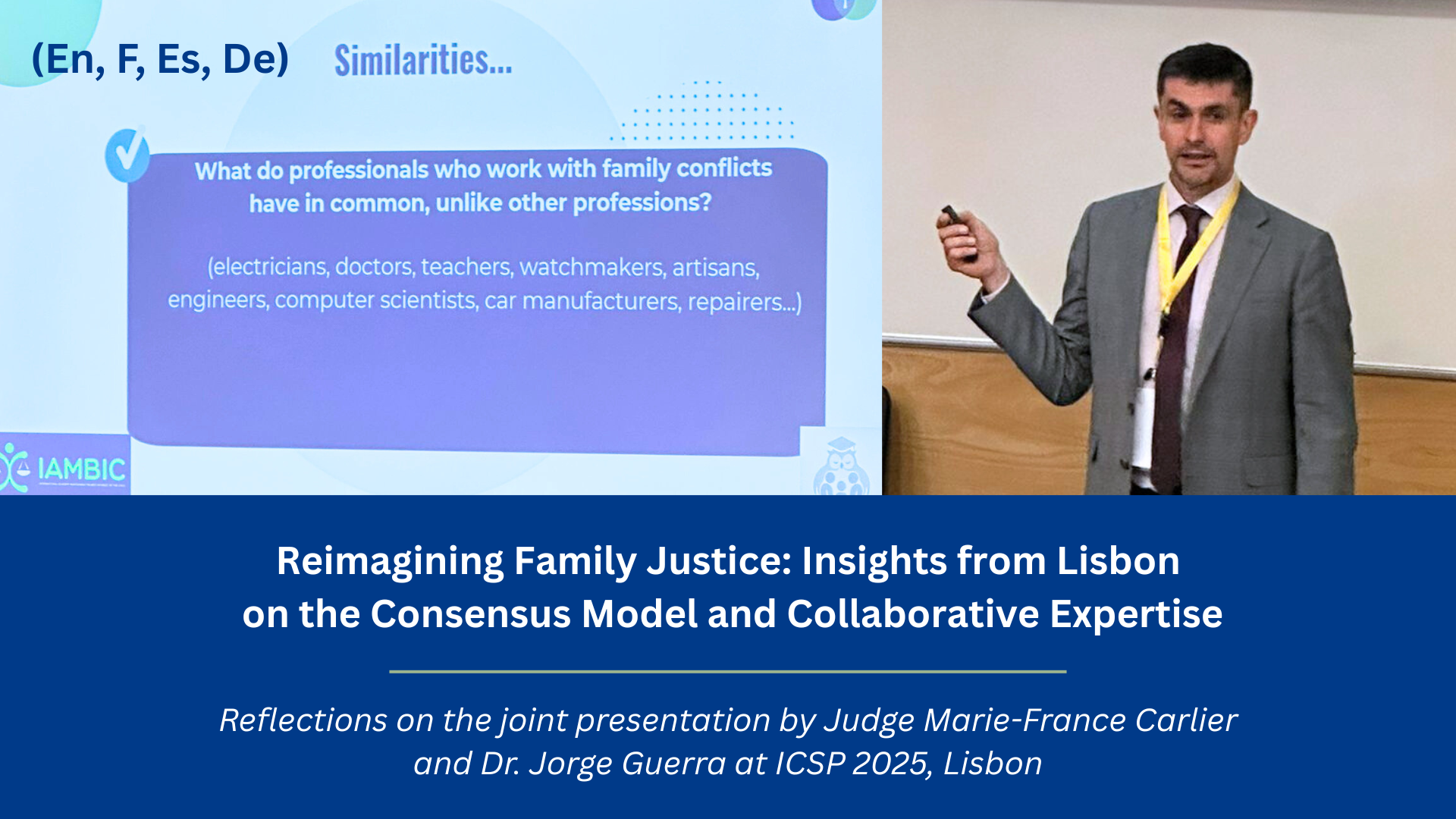
Reimagining Family Justice: Insights from Lisbon on the Consensus Model and Collaborative Expertise
Reflections on the joint presentation by Judge Marie-France Carlier and Dr. Jorge Guerra at ICSP 2025, Lisbon
Reimagining Family Justice: Insights from Lisbon on the Consensus Model and Collaborative Expertise
Reflections on the joint presentation by Judge Marie-France Carlier and Dr. Jorge Guerra at ICSP 2025, Lisbon
At the 2025 International Conference on Shared Parenting in Lisbon, Family Judge Marie-France Carlier and Dr. Jorge Guerra González delivered a thought-provoking presentation that resonated strongly with practitioners, researchers, and policymakers. Their session, titled “Optimizing the Family System for the Child’s Well-Being: The Consensus Model & Collaborative Expertise”, challenged traditional assumptions in family justice and proposed a transformative, child-centred framework for high-conflict separation cases.
This blog entry summarises their main arguments, highlights the evidence behind their proposals, and explores why Lisbon 2025 may become a reference point in the ongoing reform of family justice systems.
The Central Problem: A System Designed to Protect Children, Yet Too Often Falling Short
In most jurisdictions, the Family Protection System (FPS) is built on three promises:
- safeguarding the child’s well-being,
- assisting parents in crisis, and
- providing reliable, fair decision-making.
And yet, as Carlier and Guerra argue, these promises often fail to materialise in practice. Their presentation began with a candid diagnosis: there is a persistent discrepancy between what family justice systems are mandated to deliver and the outcomes families actually experience.
Drawing on their joint research, particularly a recent mixed-methods study registered on PsychArchives (page “Study – Results” in slides) , they illustrated this mismatch using the experiences of alienated children compared with children from separated or intact families. Both quantitative and qualitative data point to the same direction: children trapped in prolonged parental conflict fare significantly worse in their emotional well-being, mental health, and relationship stability.
The authors identify five systemic reasons for this mandate–results gap, each illustrated in their Lisbon slides :
- Legal Tradition
Family law remains deeply rooted in adversarial, binary traditions inherited from private law: A versus B, winner versus loser. This paradigm conflicts with the complex relational realities of children and parents.
- Inconsistent Application of the Legal Framework
For example:
- the child’s “will” is interpreted differently by different professionals,
- proportionality is unevenly applied,
- violations (e.g., manipulation, false allegations, non-compliance) often go without consequence.
- Limited Resources
Overloaded institutions lead to insufficient time with families, reduced depth of interventions, and shortages of qualified experts.
- The Emotional Core of Parental Conflict
Family courts rarely address the emotional, attachment-related, or neurobiological components of conflict—despite these being the true drivers of behaviour.
- Translation of Emotional Conflict into Legal Categories
Conflict is reframed into legal claims for judicial processing, which intensifies rather than resolves the underlying issues.
The conclusion is unavoidable: family justice has not been designed to deal with the emotional complexity of parental conflict, and therefore cannot deliver what children need most—relational safety, stability, and continuity.
Towards a New Family Protection System: From Decisions to Solutions
Carlier and Guerra proposed shifting from a “decision-based justice” to a “solution-based justice”. Instead of asking, “How do we decide between parents?”, the system should ask:
“How do we reduce harm and support transformation?”
This is where their two core proposals come in:
- the Consensus Model, and
- Collaborative Expertise.
The Consensus Model: Bringing Everyone Into the Same Boat
Originating from developments in Belgium, Germany, and other European jurisdictions, the Consensus Model aims for rapid, interdisciplinary management of separation cases. The idea is simple but revolutionary:
Professionals and parents row in the same direction—towards the child’s well-being—rather than remaining in adversarial positions.
Key components, as outlined in the slides (section “Consensus Model – Proposal”) :
- Early intervention immediately after separation.
- Interdisciplinary collaboration among judges, lawyers, psychologists, and social workers.
- Empowerment of parents to reach agreements themselves.
- Minimal written submissions to reduce escalation.
- A coordinated, child-focused process guiding parents from “the shore of conflict to the shore of peace”.
Judge Carlier emphasised that the model is not simply mediation; it is a systemic framework for the entire legal and psychosocial response. It recognises that early, cooperative engagement is far more effective for children than protracted litigation.
Collaborative Expertise: Belgium’s Innovative Response to High-Conflict Cases
For the most challenging cases—especially where a parent-child relationship is deteriorating—Carlier and Guerra advocate for an innovation that Belgium has developed over the past 15 years: Collaborative Expertise.
Unlike traditional expert evaluations, which often:
- exacerbate parental positions,
- create mistrust,
- or leave the emotional core unaddressed,
collaborative expertise works with both parents simultaneously, under judicial supervision, with the explicit goal of repairing communication and rebuilding trust.
The slides (section “Collaborative Expertise – Other responses”) highlight its distinctive features:
- It is not therapy—but has therapeutic effects
Judges cannot order therapy, and therapists cannot report to courts.
Collaborative expertise bridges this gap by combining support and accountability.
- It operates through a structured, progressive process
The experts provide regular interim reports (as seen in the detailed case example from 2011–2013) to maintain judicial oversight and momentum.
- It focuses on rebalancing—not forcing outcomes
There is no predetermined goal of restoring a relationship at any cost. The aim is a qualitative, sustainable balance for the child.
- It requires genuine collaboration from both parents
A central criterion for success is the willingness of both parents to participate, even minimally, in a shared process.
- It supports the judge with concrete tools
This model gives judges practical levers—something sorely missing in traditional systems—to intervene early, proportionally, and effectively.
The Case of Nicole and Sophie: A Story of Reconnection
Among the most powerful parts of the presentation was the real-life case (slides “Case Study”) of Nicole (14) and Sophie (11), who had not seen their father for 18 months.
Despite strong indicators of emotional manipulation and escalating alienation—
Nicole declared to the judge:
“My father is no longer my father since he left my mother.”
—traditional tools had failed to reverse the situation.
The collaborative expertise intervention lasted nearly two years, with a structured sequence of interim reports and judicial decisions, culminating in renewed contact and stabilised arrangements.
This case illustrates the power of sustained, coordinated interventions that address the emotional and relational dimensions—something traditional expert reports rarely achieve.
Redefining the Role of Professionals: From Evaluators to Facilitators
One of the most compelling insights from the presentation is the call to rethink professional roles:
In the FPS of the future:
- Experts are facilitators, not judges.
- Judges are coordinators, not mere arbiters.
- Parents are the primary experts on their children—not passive objects of investigation.
Carlier and Guerra emphasised that family law professionals differ from electricians, teachers, or engineers in one crucial aspect (slides “Similarities… there is no adequate evaluation”) :
Their work is almost never evaluated.
This absence of outcome-based data limits learning, improvement, and accountability.
Their proposal thus calls for a culture of evaluation and evidence—something still largely absent in many legal systems.
A Shared Vision: Justice That Heals Rather Than Harms
The presentation in Lisbon was not merely an academic critique; it was an invitation to reimagine family justice as a transformative system capable of:
- reducing harm,
- supporting children’s relationships,
- empowering parents,
- and breaking cycles of conflict.
The final message of the presentation was visually captured in their slides:
“Without change, there are no butterflies.”
A poetic reminder that systems—like families—must evolve to create something better.
Conclusion: Why This Matters Now
The Lisbon 2025 conference brought together hundreds of professionals from around the world. Amid debates on shared parenting, parental alienation, and evolving legal frameworks, the contribution of Judge Carlier and Dr. Guerra stood out because it offered:
- a clear diagnosis,
- a coherent alternative, and
- practical tools already tested in real cases.
Their message is especially urgent today, as more jurisdictions struggle with high-conflict separations, emotional manipulation, and the long-term harms inflicted on children by protracted litigation.
The Consensus Model and Collaborative Expertise remind us that solutions exist—and they start with the courage to work differently.
PORTUGUESE (PT)
Reimaginando a Justiça Familiar: Reflexões da Apresentação em Lisboa sobre o Modelo de Consenso e a Perícia Colaborativa
Na Conferência Internacional sobre Parentalidade Partilhada (ICSP 2025), em Lisboa, a Juíza (Familia) Marie-France Carlier e o Dr. Jorge Guerra González apresentaram uma intervenção profundamente inspiradora sobre a necessidade de transformar os sistemas de justiça familiar. A comunicação, intitulada “Otimizando o Sistema Familiar para o Bem-Estar da Criança: Modelo de Consenso e Perícia Colaborativa”, chamou a atenção para as limitações dos modelos tradicionais e propôs alternativas inovadoras centradas no bem-estar das crianças.
O Problema Central: Um Sistema com Boa Intenção, mas Resultados Insuficientes
Embora os sistemas de proteção familiar prometam proteger as crianças, apoiar pais em crise e garantir decisões justas, há um fosso evidente entre esses objetivos e os resultados concretos. Estudos recentes apresentados pelos autores mostram que crianças expostas a conflitos parentais intensos apresentam índices mais elevados de sofrimento emocional e dificuldades relacionais.
As razões para este desfasamento incluem:
- Tradição jurídica adversarial, centrada no confronto.
- Aplicação inconsistente da lei, sobretudo no valor atribuído à vontade da criança.
- Recursos institucionais limitados, com falta de tempo e de profissionais qualificados.
- A natureza emocional do conflito parental, frequentemente ignorada pelo direito.
- A tradução de conflitos emocionais em categorias jurídicas, o que acentua a escalada.
O Modelo de Consenso: Colocar Todos no Mesmo Barco
O Modelo de Consenso, já em prática em países como Bélgica e Alemanha, promove uma abordagem interdisciplinar rápida e colaborativa. Em vez de pais e profissionais se posicionarem como adversários, a proposta é remar juntos em direção à paz parental, com foco na criança e com mínimo de confrontação judicial.
A Perícia Colaborativa: A Resposta Belga para Casos de Alto Conflito
Nos casos mais graves — especialmente quando um vínculo parental se rompe — a perícia colaborativa oferece uma alternativa eficaz ao modelo pericial clássico, que frequentemente agrava o conflito.
Este modelo:
- não é terapia, mas tem efeitos terapêuticos;
- combina apoio e responsabilização;
- exige relatórios regulares ao tribunal;
- facilita a reconstrução de vínculos sem metas predefinidas;
- funciona apenas com a colaboração mínima de ambos os pais.
O caso apresentado de Nicole e Sophie demonstrou como este modelo pode, ao longo de meses, reconstruir um vínculo que parecia perdido.
Uma Nova Visão para os Profissionais
Os autores defendem que:
- peritos devem agir como facilitadores,
- juízes como coordenadores,
- os pais como especialistas dos seus próprios filhos.
Conclusão
A intervenção de Lisboa sublinhou que é possível transformar a justiça familiar através de colaboração, interdisciplinaridade e foco real no bem-estar das crianças. Como disseram: “Sem mudança, não há borboletas.”
🇫🇷 FRENCH (FR)
Réinventer la Justice Familiale : Regards depuis Lisbonne sur le Modèle de Consensus et l’Expertise Collaborative
Lors de la Conférence Internationale sur la Coparentalité Partagée (ICSP 2025) à Lisbonne, la Juge Marie-France Carlier et le Dr. Jorge Guerra González ont présenté une communication marquante intitulée « Optimiser le système familial pour le bien-être de l’enfant : Modèle de Consensus et Expertise Collaborative ». Leur intervention a mis en lumière les limites des procédures contentieuses traditionnelles et proposé de nouvelles voies centrées sur l’intérêt de l’enfant.
Le Problème Central : Une Justice Familiale Bien Intentionnée mais Insuffisante
Les systèmes de protection familiale promettent d’assurer le bien-être de l’enfant, d’aider les parents et de rendre des décisions équitables. Pourtant, la réalité montre un écart important entre la mission et les résultats.
Selon les données présentées, les enfants exposés à des conflits parentaux intenses souffrent davantage sur les plans émotionnel et relationnel.
Les causes principales sont :
- Une tradition juridique adversariale, orientée vers la confrontation.
- Une application inégale du cadre légal, notamment concernant la parole de l’enfant.
- Le manque de ressources et de professionnels formés.
- La nature émotionnelle du conflit parental, peu prise en compte par le droit.
- La traduction du conflit en catégories juridiques, qui intensifie la crise.
Le Modèle de Consensus : Avancer Ensemble vers la Paix Parentale
Développé en Belgique, en Allemagne et ailleurs, le Modèle de Consensus favorise une intervention rapide et interdisciplinaire. Plutôt que de renforcer les positions adverses, il vise à embarquer parents et professionnels dans la même direction, avec un minimum d’écrits et une forte responsabilisation des parents.
L’Expertise Collaborative : Une Réponse Innovante pour les Conflits Sévères
Dans les situations les plus préoccupantes — notamment lors d’une rupture du lien parent-enfant — l’expertise collaborative représente une alternative efficace aux expertises classiques.
Elle repose sur :
- un travail simultané avec les deux parents ;
- un accompagnement structuré, avec rapports réguliers au juge ;
- un équilibre entre soutien et contrôle ;
- l’absence d’objectif imposé (pas de “réunification à tout prix”).
Le cas de Nicole et Sophie illustre comment cette méthode peut restaurer progressivement un lien familial fragilisé.
Vers une Nouvelle Culture Professionnelle
Les auteurs proposent de redéfinir les rôles :
- l’expert devient facilitateur,
- le juge coordonne,
- les parents restent les principaux experts de leurs enfants.
Conclusion
L’intervention de Lisbonne montre qu’une justice familiale transformée, plus humaine et plus collaborative, est non seulement possible mais nécessaire.
« Sans changement, pas de papillons. »
🇪🇸 SPANISH (ES)
Reimaginar la Justicia Familiar: Aportes desde Lisboa sobre el Modelo de Consenso y la Pericia Colaborativa
En la Conferencia Internacional sobre Coparentalidad Compartida (ICSP 2025) en Lisboa, la jueza Marie-France Carlier y el Dr. Jorge Guerra González presentaron una ponencia destacada titulada «Optimizar el sistema familiar para el bienestar del niño: Modelo de Consenso y Pericia Colaborativa». Su exposición cuestionó las prácticas tradicionales y propuso modelos más eficaces y centrados en los niños.
El Problema: Cuando la Misión del Sistema no Coincide con los Resultados
Aunque el sistema promete proteger a los menores, apoyar a los padres y ofrecer decisiones justas, los estudios presentados muestran que existe un claro desfase entre estas metas y la realidad.
Los niños inmersos en conflictos intensos presentan mayor sufrimiento emocional y relacional.
Entre las causas identificadas:
- Una tradición jurídica adversarial, basada en el enfrentamiento.
- Aplicación desigual de la ley, especialmente en la interpretación de la voluntad del menor.
- Falta de recursos y formación especializada.
- La naturaleza emocional del conflicto parental, que raramente se aborda.
- La traducción jurídica del conflicto, que lo intensifica.
El Modelo de Consenso: Todos Remando en la Misma Dirección
El Modelo de Consenso, aplicado en países como Bélgica y Alemania, propone una intervención temprana, interdisciplinaria y colaborativa. El objetivo es que padres y profesionales avancen juntos hacia soluciones sostenibles, reduciendo el carácter adversarial del proceso.
La Pericia Colaborativa: Innovación Belga para Casos de Alto Conflicto
Frente a rupturas graves de vínculo, la pericia colaborativa ofrece una alternativa eficaz a la pericia tradicional.
Sus características principales:
- trabajo simultáneo con ambos padres;
- combinación de apoyo y supervisión;
- informes periódicos al juez;
- objetivos abiertos, sin imposiciones;
- enfoque en reconstruir la relación desde la colaboración.
El caso de Nicole y Sophie mostró cómo esta metodología puede revertir procesos de distanciamiento extremo.
Una Nueva Perspectiva Profesional
Los autores proponen una transformación profunda:
- los expertos deben actuar como facilitadores,
- los jueces como coordinadores,
- los padres como verdaderos expertos en sus hijos.
Conclusión
La ponencia de Lisboa demostró que es posible una justicia familiar menos destructiva, más colaborativa y verdaderamente centrada en los niños.
Como recordaron: «Sin cambio, no hay mariposas.»
🇩🇪 GERMAN (DE)
Familienrecht Neu Denken: Erkenntnisse aus Lissabon zum Konsensmodell und zur Kooperativen Expertise
Auf der Internationalen Konferenz zur Geteilten Elternschaft (ICSP 2025) in Lissabon präsentierten Richterin Marie-France Carlier und Dr. Jorge Guerra González einen wegweisenden Beitrag: „Optimierung des Familiensystems zum Wohl des Kindes: Konsensmodell & Kollaborative Expertise“. Die Präsentation zeigte, warum klassische familienrechtliche Verfahren häufig scheitern, und stellte innovative Modelle vor, die das Wohl des Kindes in den Mittelpunkt rücken.
Das Grundproblem: Anspruch und Wirklichkeit klaffen auseinander
Das Familienschutzsystem soll Kinder schützen, Eltern unterstützen und faire Entscheidungen gewährleisten. Doch Forschung und Praxis zeigen: Zwischen Auftrag und Ergebnis gibt es eine deutliche Lücke.
Kinder in hochstrittigen Trennungen leiden massiv unter emotionalem Stress und Beziehungsabbrüchen.
Die Gründe dafür sind u. a.:
- Adversariale Rechtstradition, die Konflikte verstärkt.
- Uneinheitliche Anwendung des Rechts, besonders bei der Bewertung des Kindeswillens.
- Begrenzte Ressourcen und Fachkräftemangel.
- Der emotionale Kern elterlicher Konflikte, der juristisch kaum berücksichtigt wird.
- Die juristische Übersetzung emotionaler Konflikte, die oft zur Eskalation führt.
Das Konsensmodell: In einem Boot, mit gemeinsamer Richtung
Das Konsensmodell fördert eine schnelle, interdisziplinäre Bearbeitung von Trennungsfällen. Im Mittelpunkt steht, dass Eltern und Fachkräfte gemeinsam an lösungsorientierten Vereinbarungen arbeiten, statt in Gegnerschaft zu verharren.
Die Kollaborative Expertise: Belgiens Antwort auf hochstrittige Fälle
Wenn ein Eltern-Kind-Verhältnis zu zerbrechen droht, bietet die kollaborative Expertise eine wirksame Alternative zur klassischen Begutachtung, die oftmals Konflikte verstärkt.
Das Modell umfasst:
- gleichzeitige Arbeit mit beiden Eltern,
- regelmäßige Zwischenberichte an das Gericht,
- eine Balance aus Unterstützung und Kontrolle,
- keine vorgegebenen Ergebnisse,
- die Zielsetzung, Beziehungen qualitativ neu auszubalancieren.
Der detaillierte Fall von Nicole und Sophie zeigte eindrucksvoll, wie über Monate hinweg ein Kontakt wiederhergestellt werden konnte.
Neues Berufsverständnis im Familienrecht
Carlier und Guerra plädieren für eine grundlegende Neuausrichtung:
- Experten als Prozessbegleiter,
- Richter als Koordinatoren,
- Eltern als wichtigste Experten ihrer Kinder.
Fazit
Die Präsentation in Lissabon machte deutlich: Familienrecht kann anders – und besser – gestaltet werden, wenn Kooperation, Interdisziplinarität und das echte Wohl des Kindes im Zentrum stehen.
„Ohne Veränderung gibt es keine Schmetterlinge.“
At the 2025 International Conference on Shared Parenting in Lisbon, Family Judge Marie-France Carlier and Dr. Jorge Guerra González delivered a thought-provoking presentation that resonated strongly with practitioners, researchers, and policymakers. Their session, titled “Optimizing the Family System for the Child’s Well-Being: The Consensus Model & Collaborative Expertise”, challenged traditional assumptions in family justice and proposed a transformative, child-centred framework for high-conflict separation cases.
This blog entry summarises their main arguments, highlights the evidence behind their proposals, and explores why Lisbon 2025 may become a reference point in the ongoing reform of family justice systems.
The Central Problem: A System Designed to Protect Children, Yet Too Often Falling Short
In most jurisdictions, the Family Protection System (FPS) is built on three promises:
- safeguarding the child’s well-being,
- assisting parents in crisis, and
- providing reliable, fair decision-making.
And yet, as Carlier and Guerra argue, these promises often fail to materialise in practice. Their presentation began with a candid diagnosis: there is a persistent discrepancy between what family justice systems are mandated to deliver and the outcomes families actually experience.
Drawing on their joint research, particularly a recent mixed-methods study registered on PsychArchives (page “Study – Results” in slides) , they illustrated this mismatch using the experiences of alienated children compared with children from separated or intact families. Both quantitative and qualitative data point to the same direction: children trapped in prolonged parental conflict fare significantly worse in their emotional well-being, mental health, and relationship stability.
The authors identify five systemic reasons for this mandate–results gap, each illustrated in their Lisbon slides :
- Legal Tradition
Family law remains deeply rooted in adversarial, binary traditions inherited from private law: A versus B, winner versus loser. This paradigm conflicts with the complex relational realities of children and parents.
- Inconsistent Application of the Legal Framework
For example:
- the child’s “will” is interpreted differently by different professionals,
- proportionality is unevenly applied,
- violations (e.g., manipulation, false allegations, non-compliance) often go without consequence.
- Limited Resources
Overloaded institutions lead to insufficient time with families, reduced depth of interventions, and shortages of qualified experts.
- The Emotional Core of Parental Conflict
Family courts rarely address the emotional, attachment-related, or neurobiological components of conflict—despite these being the true drivers of behaviour.
- Translation of Emotional Conflict into Legal Categories
Conflict is reframed into legal claims for judicial processing, which intensifies rather than resolves the underlying issues.
The conclusion is unavoidable: family justice has not been designed to deal with the emotional complexity of parental conflict, and therefore cannot deliver what children need most—relational safety, stability, and continuity.
Towards a New Family Protection System: From Decisions to Solutions
Carlier and Guerra proposed shifting from a “decision-based justice” to a “solution-based justice”. Instead of asking, “How do we decide between parents?”, the system should ask:
“How do we reduce harm and support transformation?”
This is where their two core proposals come in:
- the Consensus Model, and
- Collaborative Expertise.
The Consensus Model: Bringing Everyone Into the Same Boat
Originating from developments in Belgium, Germany, and other European jurisdictions, the Consensus Model aims for rapid, interdisciplinary management of separation cases. The idea is simple but revolutionary:
Professionals and parents row in the same direction—towards the child’s well-being—rather than remaining in adversarial positions.
Key components, as outlined in the slides (section “Consensus Model – Proposal”) :
- Early intervention immediately after separation.
- Interdisciplinary collaboration among judges, lawyers, psychologists, and social workers.
- Empowerment of parents to reach agreements themselves.
- Minimal written submissions to reduce escalation.
- A coordinated, child-focused process guiding parents from “the shore of conflict to the shore of peace”.
Judge Carlier emphasised that the model is not simply mediation; it is a systemic framework for the entire legal and psychosocial response. It recognises that early, cooperative engagement is far more effective for children than protracted litigation.
Collaborative Expertise: Belgium’s Innovative Response to High-Conflict Cases
For the most challenging cases—especially where a parent-child relationship is deteriorating—Carlier and Guerra advocate for an innovation that Belgium has developed over the past 15 years: Collaborative Expertise.
Unlike traditional expert evaluations, which often:
- exacerbate parental positions,
- create mistrust,
- or leave the emotional core unaddressed,
collaborative expertise works with both parents simultaneously, under judicial supervision, with the explicit goal of repairing communication and rebuilding trust.
The slides (section “Collaborative Expertise – Other responses”) highlight its distinctive features:
- It is not therapy—but has therapeutic effects
Judges cannot order therapy, and therapists cannot report to courts.
Collaborative expertise bridges this gap by combining support and accountability.
- It operates through a structured, progressive process
The experts provide regular interim reports (as seen in the detailed case example from 2011–2013) to maintain judicial oversight and momentum.
- It focuses on rebalancing—not forcing outcomes
There is no predetermined goal of restoring a relationship at any cost. The aim is a qualitative, sustainable balance for the child.
- It requires genuine collaboration from both parents
A central criterion for success is the willingness of both parents to participate, even minimally, in a shared process.
- It supports the judge with concrete tools
This model gives judges practical levers—something sorely missing in traditional systems—to intervene early, proportionally, and effectively.
The Case of Nicole and Sophie: A Story of Reconnection
Among the most powerful parts of the presentation was the real-life case (slides “Case Study”) of Nicole (14) and Sophie (11), who had not seen their father for 18 months.
Despite strong indicators of emotional manipulation and escalating alienation—
Nicole declared to the judge:
“My father is no longer my father since he left my mother.”
—traditional tools had failed to reverse the situation.
The collaborative expertise intervention lasted nearly two years, with a structured sequence of interim reports and judicial decisions, culminating in renewed contact and stabilised arrangements.
This case illustrates the power of sustained, coordinated interventions that address the emotional and relational dimensions—something traditional expert reports rarely achieve.
Redefining the Role of Professionals: From Evaluators to Facilitators
One of the most compelling insights from the presentation is the call to rethink professional roles:
In the FPS of the future:
- Experts are facilitators, not judges.
- Judges are coordinators, not mere arbiters.
- Parents are the primary experts on their children—not passive objects of investigation.
Carlier and Guerra emphasised that family law professionals differ from electricians, teachers, or engineers in one crucial aspect (slides “Similarities… there is no adequate evaluation”) :
Their work is almost never evaluated.
This absence of outcome-based data limits learning, improvement, and accountability.
Their proposal thus calls for a culture of evaluation and evidence—something still largely absent in many legal systems.
A Shared Vision: Justice That Heals Rather Than Harms
The presentation in Lisbon was not merely an academic critique; it was an invitation to reimagine family justice as a transformative system capable of:
- reducing harm,
- supporting children’s relationships,
- empowering parents,
- and breaking cycles of conflict.
The final message of the presentation was visually captured in their slides:
“Without change, there are no butterflies.”
A poetic reminder that systems—like families—must evolve to create something better.
Conclusion: Why This Matters Now
The Lisbon 2025 conference brought together hundreds of professionals from around the world. Amid debates on shared parenting, parental alienation, and evolving legal frameworks, the contribution of Judge Carlier and Dr. Guerra stood out because it offered:
- a clear diagnosis,
- a coherent alternative, and
- practical tools already tested in real cases.
Their message is especially urgent today, as more jurisdictions struggle with high-conflict separations, emotional manipulation, and the long-term harms inflicted on children by protracted litigation.
The Consensus Model and Collaborative Expertise remind us that solutions exist—and they start with the courage to work differently.
PORTUGUESE (PT)
Reimaginando a Justiça Familiar: Reflexões da Apresentação em Lisboa sobre o Modelo de Consenso e a Perícia Colaborativa
Na Conferência Internacional sobre Parentalidade Partilhada (ICSP 2025), em Lisboa, a Juíza (Familia) Marie-France Carlier e o Dr. Jorge Guerra González apresentaram uma intervenção profundamente inspiradora sobre a necessidade de transformar os sistemas de justiça familiar. A comunicação, intitulada “Otimizando o Sistema Familiar para o Bem-Estar da Criança: Modelo de Consenso e Perícia Colaborativa”, chamou a atenção para as limitações dos modelos tradicionais e propôs alternativas inovadoras centradas no bem-estar das crianças.
O Problema Central: Um Sistema com Boa Intenção, mas Resultados Insuficientes
Embora os sistemas de proteção familiar prometam proteger as crianças, apoiar pais em crise e garantir decisões justas, há um fosso evidente entre esses objetivos e os resultados concretos. Estudos recentes apresentados pelos autores mostram que crianças expostas a conflitos parentais intensos apresentam índices mais elevados de sofrimento emocional e dificuldades relacionais.
As razões para este desfasamento incluem:
- Tradição jurídica adversarial, centrada no confronto.
- Aplicação inconsistente da lei, sobretudo no valor atribuído à vontade da criança.
- Recursos institucionais limitados, com falta de tempo e de profissionais qualificados.
- A natureza emocional do conflito parental, frequentemente ignorada pelo direito.
- A tradução de conflitos emocionais em categorias jurídicas, o que acentua a escalada.
O Modelo de Consenso: Colocar Todos no Mesmo Barco
O Modelo de Consenso, já em prática em países como Bélgica e Alemanha, promove uma abordagem interdisciplinar rápida e colaborativa. Em vez de pais e profissionais se posicionarem como adversários, a proposta é remar juntos em direção à paz parental, com foco na criança e com mínimo de confrontação judicial.
A Perícia Colaborativa: A Resposta Belga para Casos de Alto Conflito
Nos casos mais graves — especialmente quando um vínculo parental se rompe — a perícia colaborativa oferece uma alternativa eficaz ao modelo pericial clássico, que frequentemente agrava o conflito.
Este modelo:
- não é terapia, mas tem efeitos terapêuticos;
- combina apoio e responsabilização;
- exige relatórios regulares ao tribunal;
- facilita a reconstrução de vínculos sem metas predefinidas;
- funciona apenas com a colaboração mínima de ambos os pais.
O caso apresentado de Nicole e Sophie demonstrou como este modelo pode, ao longo de meses, reconstruir um vínculo que parecia perdido.
Uma Nova Visão para os Profissionais
Os autores defendem que:
- peritos devem agir como facilitadores,
- juízes como coordenadores,
- os pais como especialistas dos seus próprios filhos.
Conclusão
A intervenção de Lisboa sublinhou que é possível transformar a justiça familiar através de colaboração, interdisciplinaridade e foco real no bem-estar das crianças. Como disseram: “Sem mudança, não há borboletas.”
🇫🇷 FRENCH (FR)
Réinventer la Justice Familiale : Regards depuis Lisbonne sur le Modèle de Consensus et l’Expertise Collaborative
Lors de la Conférence Internationale sur la Coparentalité Partagée (ICSP 2025) à Lisbonne, la Juge Marie-France Carlier et le Dr. Jorge Guerra González ont présenté une communication marquante intitulée « Optimiser le système familial pour le bien-être de l’enfant : Modèle de Consensus et Expertise Collaborative ». Leur intervention a mis en lumière les limites des procédures contentieuses traditionnelles et proposé de nouvelles voies centrées sur l’intérêt de l’enfant.
Le Problème Central : Une Justice Familiale Bien Intentionnée mais Insuffisante
Les systèmes de protection familiale promettent d’assurer le bien-être de l’enfant, d’aider les parents et de rendre des décisions équitables. Pourtant, la réalité montre un écart important entre la mission et les résultats.
Selon les données présentées, les enfants exposés à des conflits parentaux intenses souffrent davantage sur les plans émotionnel et relationnel.
Les causes principales sont :
- Une tradition juridique adversariale, orientée vers la confrontation.
- Une application inégale du cadre légal, notamment concernant la parole de l’enfant.
- Le manque de ressources et de professionnels formés.
- La nature émotionnelle du conflit parental, peu prise en compte par le droit.
- La traduction du conflit en catégories juridiques, qui intensifie la crise.
Le Modèle de Consensus : Avancer Ensemble vers la Paix Parentale
Développé en Belgique, en Allemagne et ailleurs, le Modèle de Consensus favorise une intervention rapide et interdisciplinaire. Plutôt que de renforcer les positions adverses, il vise à embarquer parents et professionnels dans la même direction, avec un minimum d’écrits et une forte responsabilisation des parents.
L’Expertise Collaborative : Une Réponse Innovante pour les Conflits Sévères
Dans les situations les plus préoccupantes — notamment lors d’une rupture du lien parent-enfant — l’expertise collaborative représente une alternative efficace aux expertises classiques.
Elle repose sur :
- un travail simultané avec les deux parents ;
- un accompagnement structuré, avec rapports réguliers au juge ;
- un équilibre entre soutien et contrôle ;
- l’absence d’objectif imposé (pas de “réunification à tout prix”).
Le cas de Nicole et Sophie illustre comment cette méthode peut restaurer progressivement un lien familial fragilisé.
Vers une Nouvelle Culture Professionnelle
Les auteurs proposent de redéfinir les rôles :
- l’expert devient facilitateur,
- le juge coordonne,
- les parents restent les principaux experts de leurs enfants.
Conclusion
L’intervention de Lisbonne montre qu’une justice familiale transformée, plus humaine et plus collaborative, est non seulement possible mais nécessaire.
« Sans changement, pas de papillons. »
🇪🇸 SPANISH (ES)
Reimaginar la Justicia Familiar: Aportes desde Lisboa sobre el Modelo de Consenso y la Pericia Colaborativa
En la Conferencia Internacional sobre Coparentalidad Compartida (ICSP 2025) en Lisboa, la jueza Marie-France Carlier y el Dr. Jorge Guerra González presentaron una ponencia destacada titulada «Optimizar el sistema familiar para el bienestar del niño: Modelo de Consenso y Pericia Colaborativa». Su exposición cuestionó las prácticas tradicionales y propuso modelos más eficaces y centrados en los niños.
El Problema: Cuando la Misión del Sistema no Coincide con los Resultados
Aunque el sistema promete proteger a los menores, apoyar a los padres y ofrecer decisiones justas, los estudios presentados muestran que existe un claro desfase entre estas metas y la realidad.
Los niños inmersos en conflictos intensos presentan mayor sufrimiento emocional y relacional.
Entre las causas identificadas:
- Una tradición jurídica adversarial, basada en el enfrentamiento.
- Aplicación desigual de la ley, especialmente en la interpretación de la voluntad del menor.
- Falta de recursos y formación especializada.
- La naturaleza emocional del conflicto parental, que raramente se aborda.
- La traducción jurídica del conflicto, que lo intensifica.
El Modelo de Consenso: Todos Remando en la Misma Dirección
El Modelo de Consenso, aplicado en países como Bélgica y Alemania, propone una intervención temprana, interdisciplinaria y colaborativa. El objetivo es que padres y profesionales avancen juntos hacia soluciones sostenibles, reduciendo el carácter adversarial del proceso.
La Pericia Colaborativa: Innovación Belga para Casos de Alto Conflicto
Frente a rupturas graves de vínculo, la pericia colaborativa ofrece una alternativa eficaz a la pericia tradicional.
Sus características principales:
- trabajo simultáneo con ambos padres;
- combinación de apoyo y supervisión;
- informes periódicos al juez;
- objetivos abiertos, sin imposiciones;
- enfoque en reconstruir la relación desde la colaboración.
El caso de Nicole y Sophie mostró cómo esta metodología puede revertir procesos de distanciamiento extremo.
Una Nueva Perspectiva Profesional
Los autores proponen una transformación profunda:
- los expertos deben actuar como facilitadores,
- los jueces como coordinadores,
- los padres como verdaderos expertos en sus hijos.
Conclusión
La ponencia de Lisboa demostró que es posible una justicia familiar menos destructiva, más colaborativa y verdaderamente centrada en los niños.
Como recordaron: «Sin cambio, no hay mariposas.»
🇩🇪 GERMAN (DE)
Familienrecht Neu Denken: Erkenntnisse aus Lissabon zum Konsensmodell und zur Kooperativen Expertise
Auf der Internationalen Konferenz zur Geteilten Elternschaft (ICSP 2025) in Lissabon präsentierten Richterin Marie-France Carlier und Dr. Jorge Guerra González einen wegweisenden Beitrag: „Optimierung des Familiensystems zum Wohl des Kindes: Konsensmodell & Kollaborative Expertise“. Die Präsentation zeigte, warum klassische familienrechtliche Verfahren häufig scheitern, und stellte innovative Modelle vor, die das Wohl des Kindes in den Mittelpunkt rücken.
Das Grundproblem: Anspruch und Wirklichkeit klaffen auseinander
Das Familienschutzsystem soll Kinder schützen, Eltern unterstützen und faire Entscheidungen gewährleisten. Doch Forschung und Praxis zeigen: Zwischen Auftrag und Ergebnis gibt es eine deutliche Lücke.
Kinder in hochstrittigen Trennungen leiden massiv unter emotionalem Stress und Beziehungsabbrüchen.
Die Gründe dafür sind u. a.:
- Adversariale Rechtstradition, die Konflikte verstärkt.
- Uneinheitliche Anwendung des Rechts, besonders bei der Bewertung des Kindeswillens.
- Begrenzte Ressourcen und Fachkräftemangel.
- Der emotionale Kern elterlicher Konflikte, der juristisch kaum berücksichtigt wird.
- Die juristische Übersetzung emotionaler Konflikte, die oft zur Eskalation führt.
Das Konsensmodell: In einem Boot, mit gemeinsamer Richtung
Das Konsensmodell fördert eine schnelle, interdisziplinäre Bearbeitung von Trennungsfällen. Im Mittelpunkt steht, dass Eltern und Fachkräfte gemeinsam an lösungsorientierten Vereinbarungen arbeiten, statt in Gegnerschaft zu verharren.
Die Kollaborative Expertise: Belgiens Antwort auf hochstrittige Fälle
Wenn ein Eltern-Kind-Verhältnis zu zerbrechen droht, bietet die kollaborative Expertise eine wirksame Alternative zur klassischen Begutachtung, die oftmals Konflikte verstärkt.
Das Modell umfasst:
- gleichzeitige Arbeit mit beiden Eltern,
- regelmäßige Zwischenberichte an das Gericht,
- eine Balance aus Unterstützung und Kontrolle,
- keine vorgegebenen Ergebnisse,
- die Zielsetzung, Beziehungen qualitativ neu auszubalancieren.
Der detaillierte Fall von Nicole und Sophie zeigte eindrucksvoll, wie über Monate hinweg ein Kontakt wiederhergestellt werden konnte.
Neues Berufsverständnis im Familienrecht
Carlier und Guerra plädieren für eine grundlegende Neuausrichtung:
- Experten als Prozessbegleiter,
- Richter als Koordinatoren,
- Eltern als wichtigste Experten ihrer Kinder.
Fazit
Die Präsentation in Lissabon machte deutlich: Familienrecht kann anders – und besser – gestaltet werden, wenn Kooperation, Interdisziplinarität und das echte Wohl des Kindes im Zentrum stehen.
„Ohne Veränderung gibt es keine Schmetterlinge.“