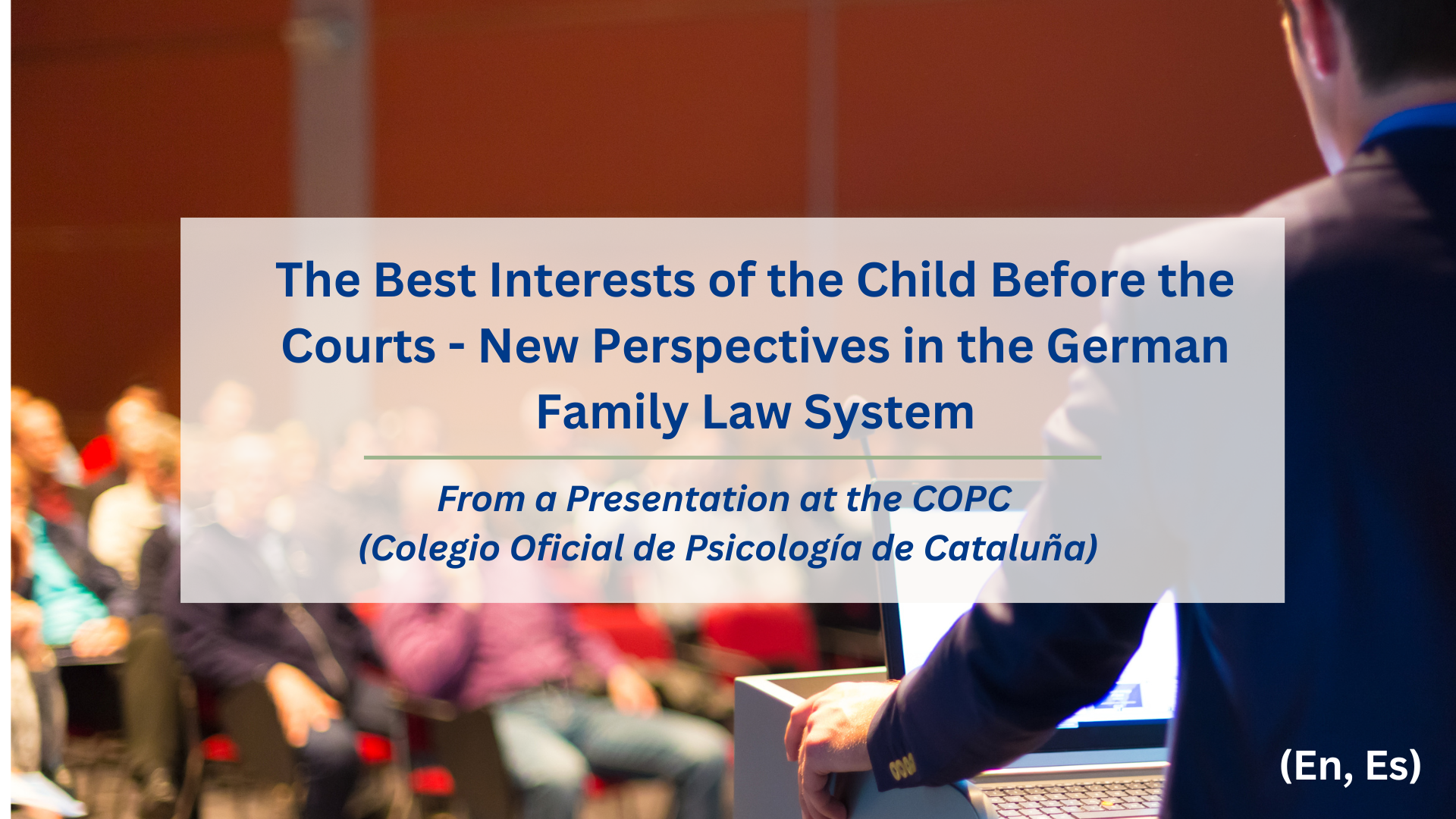
The Best Interests of the Child Before the Courts/
El interés superior del menor ante los tribunales
El interés superior del menor ante los tribunales
New Perspectives in the German Family Law System/ Nuevas Perspectivas en el Sistema Alemán de Familia
The Best Interests of the Child Before the Courts/ El interés superior del menor ante los tribunales
New Perspectives in the German Family Law System/ Nuevas Perspectivas en el Sistema Alemán de Familia
By Dr. Jorge Guerra González
On November 5th, 2025, I had the honor of speaking at the COPC (Colegio Oficial de Psicología de Cataluña, Col·legi Oficial de Psicologia de Catalunya) in Barcelona (online), presenting “The Best Interests of the Child Before the Courts: New Figures in the German Family Law System.”
It was an inspiring opportunity to reflect, together with various colleagues, on the challenges and advances in how our judicial systems seek to protect children caught in family conflict.
- The Dilemma of Our Work: Decisions Without Evaluation
I began the presentation with a question that goes straight to the core of our professional practice:
Would you trust your own family to the system you represent?
Those of us who work in family conflicts share a feature that distinguishes us from almost every other profession: our work is not properly evaluated. Unlike engineers or physicians, family court decisions — however well-intentioned — are rarely measured, compared, or scientifically analyzed.
We lack unified criteria and solid data to know whether we are truly helping families heal or unintentionally deepening their wounds.
This creates a profound gap between institutional mandate and real-world results — a discrepancy that causes frustration for both professionals and families.
- Empirical Evidence: The Impact of Family Rupture
To illustrate this discrepancy, I presented results from my comparative study on the physical and psychological well-being of alienated children, children of separated parents, and children from intact families (Guerra González, 2024; DOI: 10.23668/psycharchives.6518).
The findings confirm that minors who experienced an intentional and unjustified rupture of parental bonds report significantly lower levels of life satisfaction and emotional health than other groups.
Even more strikingly, parents often prove to be as deeply affected — or even more so — than the children themselves.
Considering that each highly conflicted family affects between three and eight people directly, the social and economic consequences are enormous. This is not merely a private matter; it is a phenomenon of broad social relevance.
- Causes of the Discrepancy: Between Legal Tradition and Emotional Reality
The German family law system, like many in continental Europe, is still rooted in a private-law tradition — A versus B, winners and losers, legal positions in conflict. Yet modern family law has a different purpose: to safeguard the child’s best interests.
And that changes everything.
Nevertheless, the system often struggles to translate this intention into practice. Several structural problems persist:
- Inconsistent application of the best interests principle.
- Limited resources, both financial and human.
- Insufficient emotional training among legal professionals.
- Translation of emotional conflicts into legal categories, which often intensifies the conflict instead of resolving it.
- Three Key Figures in the German System
Against this background, I presented three legal figures designed to address these shortcomings and bring the system closer to its true goal — protecting and supporting the child.
- a) The Child’s Counsel (Verfahrensbeistand)
Appointed by the court under §158 FamFG, this professional represents the child’s interests in judicial proceedings.
Among its strengths: the Verfahrensbeistand is often the judge’s eyes and ears, and the person who knows the case most intimately.
However, its effectiveness depends heavily on the individual — their training, empathy, and capacity to distinguish between the child’s expressed wishes and their genuine best interests.
On the downside, there remains a degree of dependence on the judge and overlap with the Youth Welfare Office (Jugendamt).
- b) The Contact Supervisor (Umgangspfleger)
Regulated by §1684 BGB, this role ensures that court-ordered contact or visitation arrangements are respected — but also mediates between parents and protects children.
This position has great conciliatory potential: the supervisor often spends the most time with the families and understands their emotional dynamics best.
Still, the absence of clear guidelines and the supervisor’s dependence on judicial discretion can limit their effectiveness.
- c) The Collaborative Expert Report (Kooperatives Gutachten)
Introduced by the 2008 Family Law Reform (the “Cochem Model”), this innovation allows judges to instruct experts not only to diagnose but also to facilitate consensus among the parties (§163 II FamFG).
It’s a more integrative vision, similar to the Belgian model, where experts are legally required to attempt reconciliation (Article 972 of the Code judiciaire).
This approach transforms the expert report from a technical assessment into a restorative process. It is generally less costly and more sustainable in the long run — though it demands continuous follow-up, professional cooperation, and goodwill from the parties.
- Toward a More Restorative Justice
The key message of my presentation was simple:
A judicial decision is not necessarily a solution.
Only when rulings seek to minimize harm and restore relationships can they fulfill the true meaning of the best interests of the child.
Family justice must integrate more mediation, interdisciplinary collaboration, and scientific evaluation of outcomes.
Family law, in essence, should evolve toward a restorative and relational form of justice, where truth, well-being, and emotional repair are not opposites but parts of the same equation.
- A Final Word
I closed my presentation with a quote from Catherine of Siena:
“It is not the quick beginning that is rewarded, but perseverance.”
Because in work with families — as in the pursuit of justice — it is perseverance, not haste, that transforms systems and lives.
It was truly an honor to share these reflections with colleagues committed to the well-being of children and to a more humane vision of law.
Nuevas Perspectivas en el Sistema Alemán de Familia
El interés superior del menor ante los tribunales
Por Dr. Jorge Guerra González
El pasado 5 de noviembre de 2025 tuve el honor de participar en una ponencia con el COPC (Colegio Oficial de Psicología de Cataluña, Col·legi Oficial de Psicologia de Catalunya) en Barcelona (online), con la ponencia “El interés superior del menor ante los tribunales: nuevas figuras en el sistema alemán de familia”. Fue una oportunidad inspiradora para reflexionar, junto a muchos colegas, sobre los retos y avances que enfrentan nuestros sistemas judiciales en la protección de los niños y niñas en contextos familiares conflictivos.
- El dilema de nuestro trabajo: decisiones sin evaluación
Comencé la presentación planteando una pregunta que toca el corazón de nuestro quehacer profesional:
¿Confiaríamos nuestra propia familia al sistema que representamos?
Quienes trabajamos en conflictos familiares compartimos una particularidad que nos diferencia de casi cualquier otra profesión: no existe una evaluación adecuada de nuestro trabajo. A diferencia de ingenieros o médicos, las decisiones judiciales en familia —por más bien intencionadas que sean— rara vez se miden, comparan o analizan científicamente. No contamos con criterios unificados ni con datos sólidos que nos permitan saber si realmente ayudamos a las familias a sanar o si, por el contrario, profundizamos su dolor.
Esto genera un desfase profundo entre el mandato institucional y los resultados reales, una discrepancia que se traduce en frustración tanto para los profesionales como para las familias.
- La evidencia empírica: el impacto de las rupturas familiares
Para ilustrar esta discrepancia, presenté resultados de mi estudio comparativo sobre el bienestar físico y psíquico de menores alienados, de hijos de padres separados y de hijos de familias intactas (Guerra González, 2024; DOI: 10.23668/psycharchives.6518).
Los datos confirman que los menores que han sufrido una ruptura intencionada e injustificada de los vínculos parentales muestran niveles significativamente más bajos de satisfacción vital y salud emocional que los otros grupos. Pero también revelan algo aún más inquietante: los padres, en muchos casos, resultan tan o más afectados que los propios niños.
Si consideramos que por cada familia en alto conflicto hay entre tres y ocho personas directamente impactadas, las consecuencias sociales y económicas son inmensas. No se trata solo de un asunto privado, sino de un fenómeno de relevancia social profunda.
- Causas de la discrepancia: entre la tradición y la realidad emocional
El sistema alemán de familia, como muchos otros en Europa continental, sigue anclado en una tradición jurídica de derecho privado: A contra B, ganadores y perdedores, posiciones jurídicas en conflicto. Pero el derecho de familia actual tiene otro propósito: velar por el bienestar infantil. Y eso lo cambia todo.
Sin embargo, el sistema no siempre logra traducir esta intención en la práctica. Persisten problemas estructurales:
- Aplicación inconsistente del principio del interés superior del menor.
- Recursos limitados, tanto económicos como humanos.
- Déficit de formación emocional entre los operadores jurídicos.
- Traducción inadecuada del conflicto parental a categorías jurídicas, lo que a menudo agrava la escalada emocional.
- Tres figuras claves del sistema alemán (y belga)
En este contexto, presenté tres figuras que intentan responder a estas carencias y acercar el sistema a su verdadero objetivo: proteger y acompañar al menor.
- a) El abogado del menor (Verfahrensbeistand)
Nombrado por el tribunal conforme al §158 FamFG, este profesional defiende los intereses del niño en el proceso judicial.
Entre sus luces, destaco que suele ser los “ojos y oídos” del juez, el que mejor conoce la situación real de los implicados. Sin embargo, su efectividad depende mucho de la persona: su formación, empatía y capacidad para diferenciar entre la voluntad expresada y el auténtico interés del menor. Entre sus sombras, persiste cierta dependencia del juez y duplicidad con el Jugendamt.
- b) El tutor del régimen de visitas (Umgangspfleger)
Previsto en el §1684 BGB, su función es hacer cumplir las visitas ordenadas por el tribunal, pero también mediar y proteger a los menores. Este rol tiene gran potencial conciliador, pues el tutor es a menudo quien más tiempo pasa con las familias y quien mejor comprende su dinámica emocional.
Sin embargo, también aquí la falta de guías normativas y la dependencia judicial pueden limitar su eficacia.
- c) El peritaje colaborativo (Lösungsorientiertes Gutachten; Expertise Collaborative)
Introducido por la reforma de 2008 (modelo Cochem), esta modalidad permite al juez encargar al perito no solo un diagnóstico, sino también favorecer un consenso entre las partes (§163 II FamFG).
Se trata de una visión más integradora, cercana a la práctica belga, donde el perito está obligado por ley a intentar la conciliación (art. 972 del Code judiciaire). Este modelo busca transformar el peritaje de un ejercicio técnico en un proceso reparador. Su gran ventaja es que reduce costes y daños a largo plazo, aunque requiere seguimiento, cooperación profesional y voluntad de las partes.
- Hacia una justicia más restaurativa
La conclusión de mi ponencia fue clara:
una decisión judicial no siempre es una solución.
Solo cuando las resoluciones buscan minimizar el daño y restaurar los vínculos, pueden cumplir con el verdadero sentido del interés superior del menor. Los sistemas jurídicos deben integrar más mediación, colaboración interdisciplinar y evaluación científica de resultados.
El derecho de familia necesita evolucionar hacia una justicia restaurativa y relacional, donde la verdad, el bienestar y la reparación emocional no sean conceptos opuestos, sino partes de una misma ecuación.
- A modo de cierre
Terminé mi intervención citando a Catalina de Siena:
“No es el comienzo rápido lo que se recompensa, sino la perseverancia.”
Porque en el trabajo con familias, como en la búsqueda de justicia, la perseverancia —y no la prisa— es la que transforma los sistemas y las vidas.
Fue, sin duda, un honor poder compartir estas reflexiones con colegas comprometidos con el bienestar infantil y con una visión más humana del derecho.
By Dr. Jorge Guerra González
On November 5th, 2025, I had the honor of speaking at the COPC (Colegio Oficial de Psicología de Cataluña, Col·legi Oficial de Psicologia de Catalunya) in Barcelona (online), presenting “The Best Interests of the Child Before the Courts: New Figures in the German Family Law System.”
It was an inspiring opportunity to reflect, together with various colleagues, on the challenges and advances in how our judicial systems seek to protect children caught in family conflict.
- The Dilemma of Our Work: Decisions Without Evaluation
I began the presentation with a question that goes straight to the core of our professional practice:
Would you trust your own family to the system you represent?
Those of us who work in family conflicts share a feature that distinguishes us from almost every other profession: our work is not properly evaluated. Unlike engineers or physicians, family court decisions — however well-intentioned — are rarely measured, compared, or scientifically analyzed.
We lack unified criteria and solid data to know whether we are truly helping families heal or unintentionally deepening their wounds.
This creates a profound gap between institutional mandate and real-world results — a discrepancy that causes frustration for both professionals and families.
- Empirical Evidence: The Impact of Family Rupture
To illustrate this discrepancy, I presented results from my comparative study on the physical and psychological well-being of alienated children, children of separated parents, and children from intact families (Guerra González, 2024; DOI: 10.23668/psycharchives.6518).
The findings confirm that minors who experienced an intentional and unjustified rupture of parental bonds report significantly lower levels of life satisfaction and emotional health than other groups.
Even more strikingly, parents often prove to be as deeply affected — or even more so — than the children themselves.
Considering that each highly conflicted family affects between three and eight people directly, the social and economic consequences are enormous. This is not merely a private matter; it is a phenomenon of broad social relevance.
- Causes of the Discrepancy: Between Legal Tradition and Emotional Reality
The German family law system, like many in continental Europe, is still rooted in a private-law tradition — A versus B, winners and losers, legal positions in conflict. Yet modern family law has a different purpose: to safeguard the child’s best interests.
And that changes everything.
Nevertheless, the system often struggles to translate this intention into practice. Several structural problems persist:
- Inconsistent application of the best interests principle.
- Limited resources, both financial and human.
- Insufficient emotional training among legal professionals.
- Translation of emotional conflicts into legal categories, which often intensifies the conflict instead of resolving it.
- Three Key Figures in the German System
Against this background, I presented three legal figures designed to address these shortcomings and bring the system closer to its true goal — protecting and supporting the child.
- a) The Child’s Counsel (Verfahrensbeistand)
Appointed by the court under §158 FamFG, this professional represents the child’s interests in judicial proceedings.
Among its strengths: the Verfahrensbeistand is often the judge’s eyes and ears, and the person who knows the case most intimately.
However, its effectiveness depends heavily on the individual — their training, empathy, and capacity to distinguish between the child’s expressed wishes and their genuine best interests.
On the downside, there remains a degree of dependence on the judge and overlap with the Youth Welfare Office (Jugendamt).
- b) The Contact Supervisor (Umgangspfleger)
Regulated by §1684 BGB, this role ensures that court-ordered contact or visitation arrangements are respected — but also mediates between parents and protects children.
This position has great conciliatory potential: the supervisor often spends the most time with the families and understands their emotional dynamics best.
Still, the absence of clear guidelines and the supervisor’s dependence on judicial discretion can limit their effectiveness.
- c) The Collaborative Expert Report (Kooperatives Gutachten)
Introduced by the 2008 Family Law Reform (the “Cochem Model”), this innovation allows judges to instruct experts not only to diagnose but also to facilitate consensus among the parties (§163 II FamFG).
It’s a more integrative vision, similar to the Belgian model, where experts are legally required to attempt reconciliation (Article 972 of the Code judiciaire).
This approach transforms the expert report from a technical assessment into a restorative process. It is generally less costly and more sustainable in the long run — though it demands continuous follow-up, professional cooperation, and goodwill from the parties.
- Toward a More Restorative Justice
The key message of my presentation was simple:
A judicial decision is not necessarily a solution.
Only when rulings seek to minimize harm and restore relationships can they fulfill the true meaning of the best interests of the child.
Family justice must integrate more mediation, interdisciplinary collaboration, and scientific evaluation of outcomes.
Family law, in essence, should evolve toward a restorative and relational form of justice, where truth, well-being, and emotional repair are not opposites but parts of the same equation.
- A Final Word
I closed my presentation with a quote from Catherine of Siena:
“It is not the quick beginning that is rewarded, but perseverance.”
Because in work with families — as in the pursuit of justice — it is perseverance, not haste, that transforms systems and lives.
It was truly an honor to share these reflections with colleagues committed to the well-being of children and to a more humane vision of law.
Nuevas Perspectivas en el Sistema Alemán de Familia
El interés superior del menor ante los tribunales
Por Dr. Jorge Guerra González
El pasado 5 de noviembre de 2025 tuve el honor de participar en una ponencia con el COPC (Colegio Oficial de Psicología de Cataluña, Col·legi Oficial de Psicologia de Catalunya) en Barcelona (online), con la ponencia “El interés superior del menor ante los tribunales: nuevas figuras en el sistema alemán de familia”. Fue una oportunidad inspiradora para reflexionar, junto a muchos colegas, sobre los retos y avances que enfrentan nuestros sistemas judiciales en la protección de los niños y niñas en contextos familiares conflictivos.
- El dilema de nuestro trabajo: decisiones sin evaluación
Comencé la presentación planteando una pregunta que toca el corazón de nuestro quehacer profesional:
¿Confiaríamos nuestra propia familia al sistema que representamos?
Quienes trabajamos en conflictos familiares compartimos una particularidad que nos diferencia de casi cualquier otra profesión: no existe una evaluación adecuada de nuestro trabajo. A diferencia de ingenieros o médicos, las decisiones judiciales en familia —por más bien intencionadas que sean— rara vez se miden, comparan o analizan científicamente. No contamos con criterios unificados ni con datos sólidos que nos permitan saber si realmente ayudamos a las familias a sanar o si, por el contrario, profundizamos su dolor.
Esto genera un desfase profundo entre el mandato institucional y los resultados reales, una discrepancia que se traduce en frustración tanto para los profesionales como para las familias.
- La evidencia empírica: el impacto de las rupturas familiares
Para ilustrar esta discrepancia, presenté resultados de mi estudio comparativo sobre el bienestar físico y psíquico de menores alienados, de hijos de padres separados y de hijos de familias intactas (Guerra González, 2024; DOI: 10.23668/psycharchives.6518).
Los datos confirman que los menores que han sufrido una ruptura intencionada e injustificada de los vínculos parentales muestran niveles significativamente más bajos de satisfacción vital y salud emocional que los otros grupos. Pero también revelan algo aún más inquietante: los padres, en muchos casos, resultan tan o más afectados que los propios niños.
Si consideramos que por cada familia en alto conflicto hay entre tres y ocho personas directamente impactadas, las consecuencias sociales y económicas son inmensas. No se trata solo de un asunto privado, sino de un fenómeno de relevancia social profunda.
- Causas de la discrepancia: entre la tradición y la realidad emocional
El sistema alemán de familia, como muchos otros en Europa continental, sigue anclado en una tradición jurídica de derecho privado: A contra B, ganadores y perdedores, posiciones jurídicas en conflicto. Pero el derecho de familia actual tiene otro propósito: velar por el bienestar infantil. Y eso lo cambia todo.
Sin embargo, el sistema no siempre logra traducir esta intención en la práctica. Persisten problemas estructurales:
- Aplicación inconsistente del principio del interés superior del menor.
- Recursos limitados, tanto económicos como humanos.
- Déficit de formación emocional entre los operadores jurídicos.
- Traducción inadecuada del conflicto parental a categorías jurídicas, lo que a menudo agrava la escalada emocional.
- Tres figuras claves del sistema alemán (y belga)
En este contexto, presenté tres figuras que intentan responder a estas carencias y acercar el sistema a su verdadero objetivo: proteger y acompañar al menor.
- a) El abogado del menor (Verfahrensbeistand)
Nombrado por el tribunal conforme al §158 FamFG, este profesional defiende los intereses del niño en el proceso judicial.
Entre sus luces, destaco que suele ser los “ojos y oídos” del juez, el que mejor conoce la situación real de los implicados. Sin embargo, su efectividad depende mucho de la persona: su formación, empatía y capacidad para diferenciar entre la voluntad expresada y el auténtico interés del menor. Entre sus sombras, persiste cierta dependencia del juez y duplicidad con el Jugendamt.
- b) El tutor del régimen de visitas (Umgangspfleger)
Previsto en el §1684 BGB, su función es hacer cumplir las visitas ordenadas por el tribunal, pero también mediar y proteger a los menores. Este rol tiene gran potencial conciliador, pues el tutor es a menudo quien más tiempo pasa con las familias y quien mejor comprende su dinámica emocional.
Sin embargo, también aquí la falta de guías normativas y la dependencia judicial pueden limitar su eficacia.
- c) El peritaje colaborativo (Lösungsorientiertes Gutachten; Expertise Collaborative)
Introducido por la reforma de 2008 (modelo Cochem), esta modalidad permite al juez encargar al perito no solo un diagnóstico, sino también favorecer un consenso entre las partes (§163 II FamFG).
Se trata de una visión más integradora, cercana a la práctica belga, donde el perito está obligado por ley a intentar la conciliación (art. 972 del Code judiciaire). Este modelo busca transformar el peritaje de un ejercicio técnico en un proceso reparador. Su gran ventaja es que reduce costes y daños a largo plazo, aunque requiere seguimiento, cooperación profesional y voluntad de las partes.
- Hacia una justicia más restaurativa
La conclusión de mi ponencia fue clara:
una decisión judicial no siempre es una solución.
Solo cuando las resoluciones buscan minimizar el daño y restaurar los vínculos, pueden cumplir con el verdadero sentido del interés superior del menor. Los sistemas jurídicos deben integrar más mediación, colaboración interdisciplinar y evaluación científica de resultados.
El derecho de familia necesita evolucionar hacia una justicia restaurativa y relacional, donde la verdad, el bienestar y la reparación emocional no sean conceptos opuestos, sino partes de una misma ecuación.
- A modo de cierre
Terminé mi intervención citando a Catalina de Siena:
“No es el comienzo rápido lo que se recompensa, sino la perseverancia.”
Porque en el trabajo con familias, como en la búsqueda de justicia, la perseverancia —y no la prisa— es la que transforma los sistemas y las vidas.
Fue, sin duda, un honor poder compartir estas reflexiones con colegas comprometidos con el bienestar infantil y con una visión más humana del derecho.